

You walk into a clinic expecting one doctor to handle everything. Your blood pressure, your cholesterol, the weird rash on your arm, and that new prescription for high blood pressure. In the old model, this worked fine if you were healthy and young. But for patients with multiple chronic conditions taking five or more medications, the single-doctor model is breaking down. It creates blind spots. It misses drug interactions. And it often leaves expensive brand-name drugs on the list when a safe, effective generic was available all along.
This is where Team-Based Care changes the game. It’s not just a buzzword; it’s a structural shift in how healthcare is delivered. Instead of a lone physician making every call, a coordinated group-including pharmacists, nurses, and care coordinators-works together to manage your health. When applied to generic prescribing, this approach doesn’t just save money; it improves safety and adherence. Let’s look at how this actually works, who does what, and why it matters for both providers and patients.
What Team-Based Care Actually Means
The National Academy of Medicine defines team-based care as a model where multiple health providers work with patients and caregivers to accomplish shared goals across settings. Think of it less like a hierarchy and more like a jazz band. Everyone has a specific instrument (role), but they listen to each other to keep the rhythm (care coordination) tight. This formalized structure gained traction after the Institute of Medicine’s 2001 report "Crossing the Quality Chasm" highlighted fragmented care as a major quality barrier. Since then, Medicare demonstration projects and legislation like the Medicare Prescription Drug Improvement and Modernization Act of 2003 have pushed these models forward.
In the context of medication, the goal is simple: optimize therapeutic outcomes while reducing costs. A key mechanism here is the Collaborative Practice Agreement (CPA). As noted by CDC resources, CPAs formalize relationships between pharmacists and prescribers. They allow pharmacists to adjust dosages, switch brands to generics, or stop redundant meds under established protocols without needing a direct phone call to the doctor for every minor change. This delegation frees up physicians to focus on complex diagnostic decisions rather than administrative medication tweaks.
The Role of Pharmacists in Generic Substitution
If there’s one entity driving the success of team-based generic prescribing, it’s the pharmacist. Historically, pharmacists were dispensers. Today, in advanced team models, they are clinical decision-makers. According to Dr. Barbara G. Wells, CEO of the American Pharmacists Association, integrating pharmacists into care teams can reduce medication errors by 67% and improve adherence rates by 28%. How? By catching issues before they become problems.
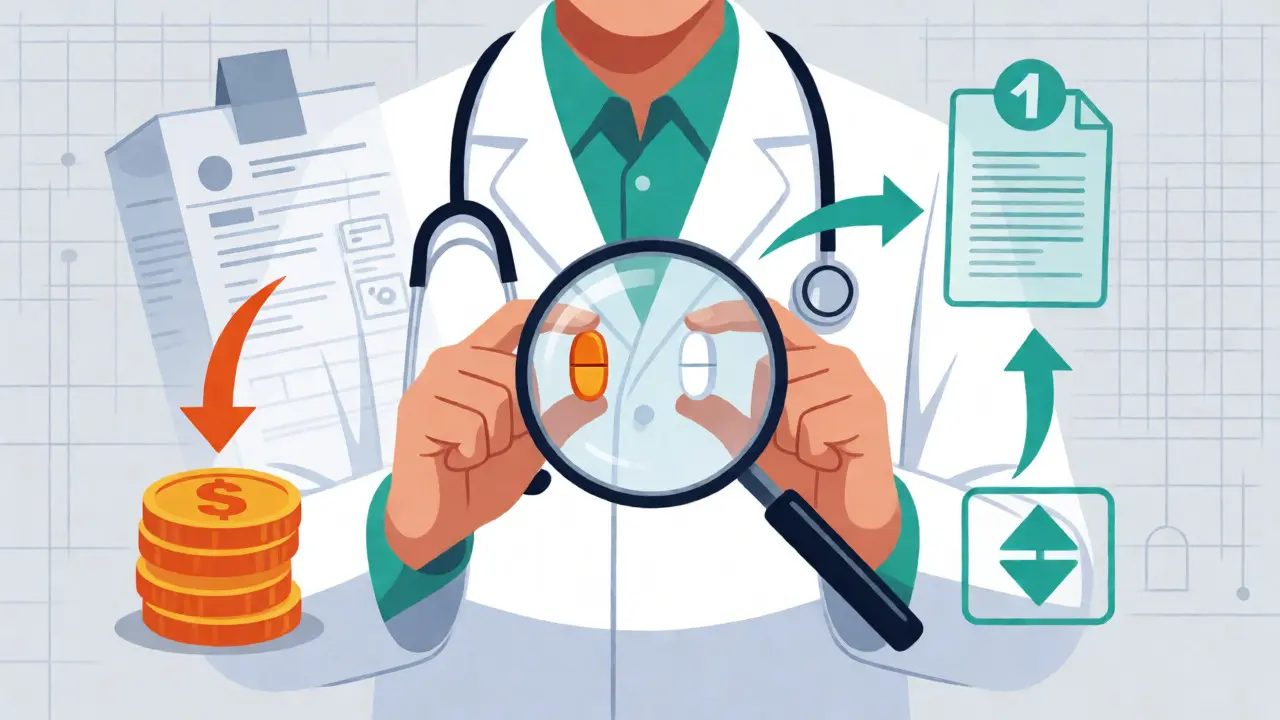
Consider a patient with diabetes and hypertension. The physician prescribes a brand-name antihypertensive. The pharmacist, conducting a comprehensive medication review, identifies that a generic equivalent is bioequivalent, cheaper, and fits the patient’s insurance tier better. In a traditional siloed system, the pharmacist might just dispense the brand name and hope for the best. In a team-based model, the pharmacist consults the CPA protocol, switches the patient to the generic, documents the change, and informs the physician. The patient saves $200 a month, and the physician gets a note confirming the switch was clinically appropriate.
This isn’t hypothetical. Data from PureView Health Center shows that team-based medication management can save $1,200-$1,800 annually per patient through appropriate generic substitution and avoiding preventable hospitalizations. The pharmacist becomes the gatekeeper of cost-effective therapy, ensuring that "cheaper" never means "worse."
How the Team Divides Labor
Effective team-based care relies on clear roles. If everyone tries to do everything, no one does anything well. Here is how responsibilities typically break down in a multidisciplinary approach to medication management:
| Provider Role | Primary Responsibility | Generic Prescribing Function |
|---|---|---|
| Physician | Medical oversight, diagnosis, complex decision-making. | Approves initial therapy plans; reviews pharmacist recommendations for complex cases. |
| Pharmacist | Comprehensive medication reviews, therapeutic recommendations. | Identifies generic alternatives; manages substitutions via CPA; educates on adherence. |
| Nurse/NP | Chronic disease monitoring, patient education. | Monitors side effects of generic switches; reinforces adherence during visits. |
| Care Coordinator | Facilitates communication, tracks referrals. | Ensures patient receives updated med lists after generic switches; schedules follow-ups. |
This division of labor reduces friction. Physicians aren’t bogged down by routine formulary checks. Pharmacists aren’t ignored because they’re "just dispensing." Nurses get clear instructions on what to monitor after a switch. It creates synergy, leading to less waste and fewer errors.
Implementation Challenges and Realities
It sounds perfect, right? But implementation is messy. Setting up a robust team-based model isn’t free. Reports from the VA Health Services Research & Development Service indicate initial setup costs can range from $85,000 to $120,000 per practice. This includes hiring clinical pharmacists, configuring electronic health records (EHR) to support team notes, and training staff.
There’s also the human factor. Some physicians resist delegating medication decisions. They worry about losing control or liability. Dr. Richard Baron, former CEO of the American Board of Internal Medicine, cautioned against over-reliance on non-physician team members, citing a 5.2% error rate in medication recommendations in certain studies. While small, this risk requires trust-building. Teams need daily huddles-often just 15 minutes-to align on high-risk patients.
Technology plays a huge role here. Practices that successfully implement team-based care often see a 35% reduction in medication reconciliation time because their EHR systems are integrated. Without this tech backbone, communication breaks down. Patients get confused about which version of their medication list is current. A common complaint in negative reviews involves exactly this: communication gaps leading to medication confusion during transitions between providers.

Who Benefits Most?
Not every patient needs a full team-based intervention. The model shines brightest for those with multimorbidity-patients dealing with three or more chronic conditions like diabetes, hypertension, asthma, or heart failure. These are the people likely taking five or more medications. For them, the complexity of managing drug-drug interactions and cost barriers makes the pharmacist’s role critical.
Medicare Part D’s Medication Therapy Management (MTM) programs target this exact demographic. As of 2023, CMS expanded eligibility to include patients taking four or more medications, potentially adding millions to the pool. If you fit this profile, ask your provider if they utilize collaborative practice agreements. Do they have a pharmacist on staff or contracted? If yes, you’re likely getting a higher standard of care regarding generic options.
Conversely, acute episodic care-like treating a broken bone or a sudden infection-doesn’t always benefit from deep team consultation. Speed is often prioritized over optimization in these scenarios. However, even in acute care, a quick pharmacist check can prevent prescribing an unnecessary brand-name antibiotic when a cheap generic amoxicillin would suffice.
The Future: AI and Virtual Teams
The landscape is evolving rapidly. Telepharmacy services grew by 214% between 2020 and 2023, allowing rural patients to access specialist medication management remotely. Now, artificial intelligence is entering the chat. Pilot programs at institutions like Mayo Clinic are testing AI tools that suggest generic substitutions based on real-time formulary data and patient history. Early results show a 22% increase in appropriate generic utilization.
This doesn’t replace the human element. AI flags the option; the team decides. The future of generic prescribing isn’t about algorithms making choices; it’s about algorithms giving teams better data so they can make faster, safer choices. With 92% of healthcare executives planning to expand team-based services, this model is becoming the standard, not the exception.
What is a Collaborative Practice Agreement (CPA)?
A CPA is a legal document that allows a pharmacist to perform certain functions, such as adjusting medication doses or switching brand-name drugs to generics, under a pre-established protocol agreed upon by a physician. It streamlines care by removing the need for individual physician approval for every minor medication change.
Does switching to generic drugs affect treatment effectiveness?
No. The FDA requires generic drugs to have the same active ingredient, strength, dosage form, and route of administration as the brand-name drug. They must also demonstrate bioequivalence, meaning they are absorbed into the body at the same rate and extent. Team-based care ensures these switches are monitored for any individual patient response differences.
Why is team-based care better for medication management?
It reduces errors and costs. Studies show team-based approaches can reduce adverse events like hospital readmissions by 17.3% and decrease duplicative testing by 22.8%. By leveraging pharmacists' expertise in drug interactions and cost-effective alternatives, teams optimize therapy more efficiently than a single provider could alone.
Are pharmacists allowed to prescribe medications?
This varies by state law. In many jurisdictions, pharmacists cannot independently diagnose and prescribe new therapies but can initiate, modify, or discontinue existing medications under a CPA or standing orders. Their primary role in generic prescribing is usually substitution and optimization within existing treatment plans.
How does team-based care help with medication adherence?
By simplifying regimens and addressing cost barriers. Pharmacists and nurses educate patients on *why* a generic switch is safe and affordable. When patients understand the rationale and don't face sticker shock at the pharmacy counter, they are more likely to take their medications consistently. Adherence rates have been shown to improve by up to 28% in these models.





9 Comments