You walk into a busy coffee shop. The barista asks for your name over the hiss of an espresso machine and the clatter of cups. You smile, nod, and guess "Dave." It’s actually Dave. But what if it was David? Or Dan? That moment of hesitation, that slight disconnect between sound and meaning, is more than just awkward-it’s a signal. For millions of people, this isn't a rare glitch; it's daily life.
Hearing loss affects over 1.5 billion people globally, according to the World Health Organization. Yet, only about 34 million of those who could benefit are using hearing aids, which are electronic devices designed to amplify sound for individuals with hearing loss. Why such a gap? Often, it’s confusion. The technology has shifted dramatically in the last five years. We’ve moved from bulky analog boxes to tiny, AI-powered computers that sit behind your ear or inside your canal. If you are considering help for your hearing, understanding the types, the fitting process, and the tech inside is crucial. Let’s break down what matters in 2026.
The Big Shift: Prescription vs. Over-the-Counter (OTC)
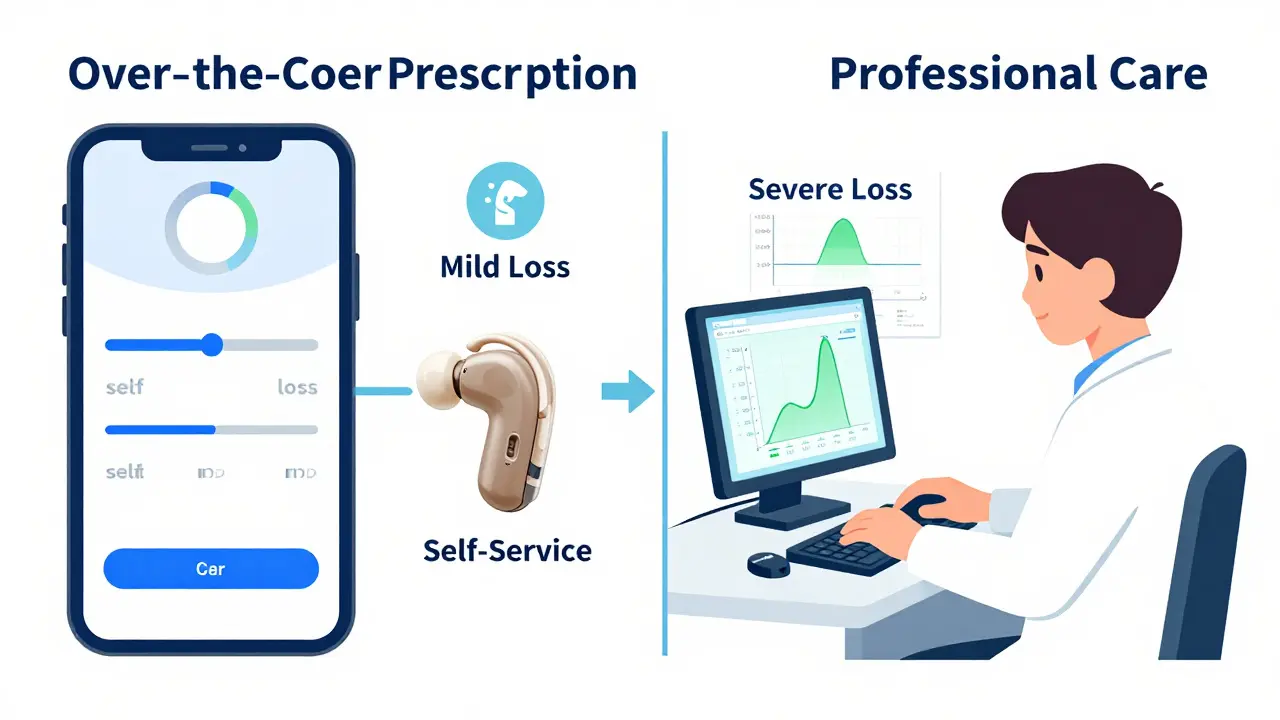
The biggest change in the hearing aid landscape recently is access. Until late 2022, you had to see an audiologist to get any device. Now, thanks to FDA rules effective October 2022, adults with mild-to-moderate hearing loss can buy devices directly online or in stores. These are called Over-the-Counter (OTC) hearing aids.
This split creates two distinct paths for buyers:
- OTC Hearing Aids: Best for adults who perceive their hearing loss as mild to moderate. They are cheaper, easier to get, and rely on smartphone apps for self-fitting. Brands like Jabra Enhance Select dominate this space.
- Prescription Hearing Aids: Required for severe to profound hearing loss, or for anyone wanting maximum customization. These are fitted by professionals and offer advanced features like bone conduction integration and complex noise reduction algorithms.
If you have trouble hearing high-pitched sounds (like birds chirping or women’s voices) but hear low rumbles fine, an OTC device might work. If you struggle in noisy rooms or need significant volume boost, prescription models are safer bets. Dr. Mark Ross from the Journal of the American Academy of Audiology noted in 2025 that 68% of OTC users experienced suboptimal results due to self-fitting errors. This doesn’t mean OTC is bad-it means you have to do the homework yourself.
Types of Hearing Aids: Style Matters More Than You Think
Not all hearing aids look or perform the same. The style you choose depends on three things: the severity of your hearing loss, the size of your ears, and your manual dexterity. Here are the main categories available in 2026.
| Style | Best For | Battery Life | Key Feature |
|---|---|---|---|
| Behind-the-Ear (BTE) | Severe to Profound Loss | 1-3 Weeks (Rechargeable) | Durable, powerful amplification |
| Receiver-in-Canal (RIC) | Mild to Severe Loss | 24+ Hours | Natural sound, discreet receiver |
| In-the-Ear (ITE) | Mild to Moderate Loss | 30+ Hours | Easier controls, custom fit |
| Completely-in-Canal (CIC) | Mild to Moderate Loss | 16-20 Hours | Virtually invisible |
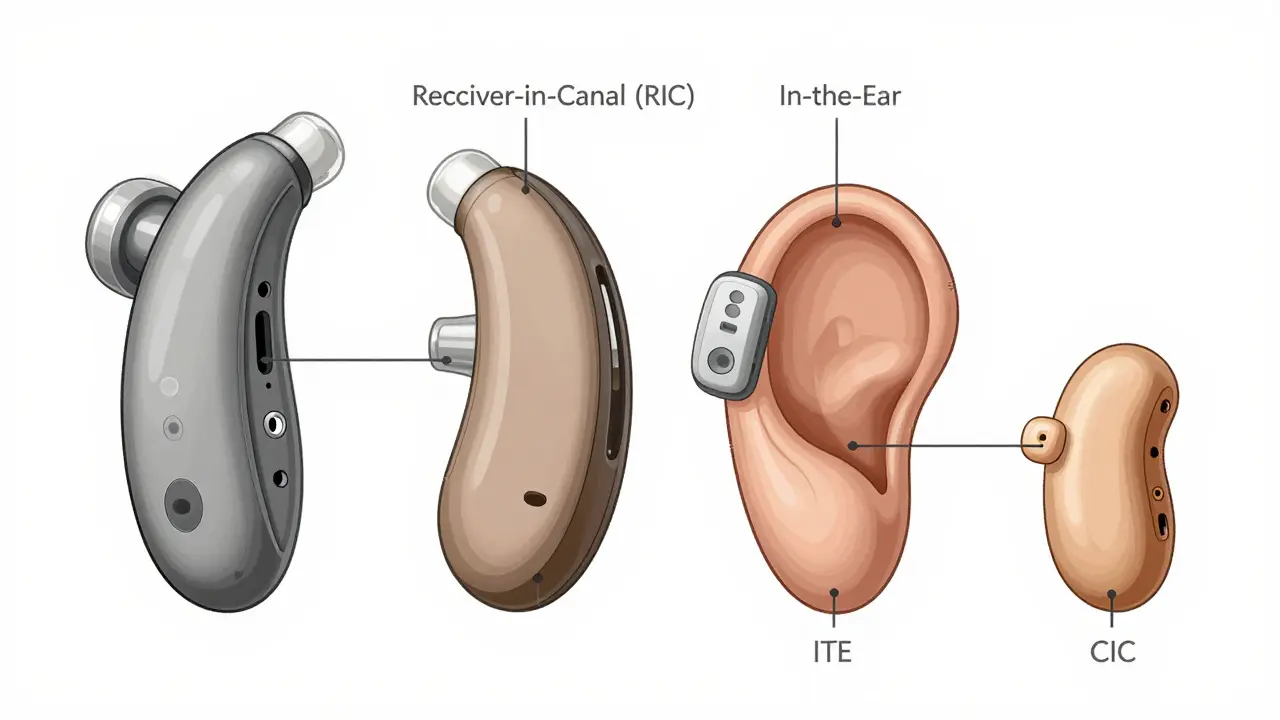
Behind-the-Ear (BTE): These sit behind your pinna (the outer ear) with a tube connecting to an earpiece. Models like the Phonak Naída Lumity L-UP are heavy hitters. They handle severe hearing loss well because they have room for bigger batteries and stronger speakers. They are also robust-many come with IP68 water resistance, meaning sweat and rain won’t kill them instantly.
Receiver-in-Canal (RIC): This is the most popular style today. Like BTEs, they sit behind the ear, but the speaker (receiver) sits inside the ear canal. This allows sound to enter more naturally, reducing the "blocked" feeling. The Jabra Enhance Select 700 is a top-rated RIC model that offers LE Audio support, which improves streaming quality from phones.
In-the-Ear (ITE) and CIC: These are custom-molded to fit your ear. ITE fills the bowl of your ear, while CIC goes deeper. They are great for cosmetics-you barely see them-but they have smaller batteries and fewer microphones. If you love music or live in a noisy city, the limited microphone array in CIC models can be a drawback.
Amplification Technology: What’s Inside the Box?
Modern hearing aids aren’t just amplifiers; they are mini-computers. In the 1990s, digital processing meant simple volume boosts. Today, we’re talking about Artificial Intelligence (AI) and dual-chip architecture.
Here is how the tech works under the hood:
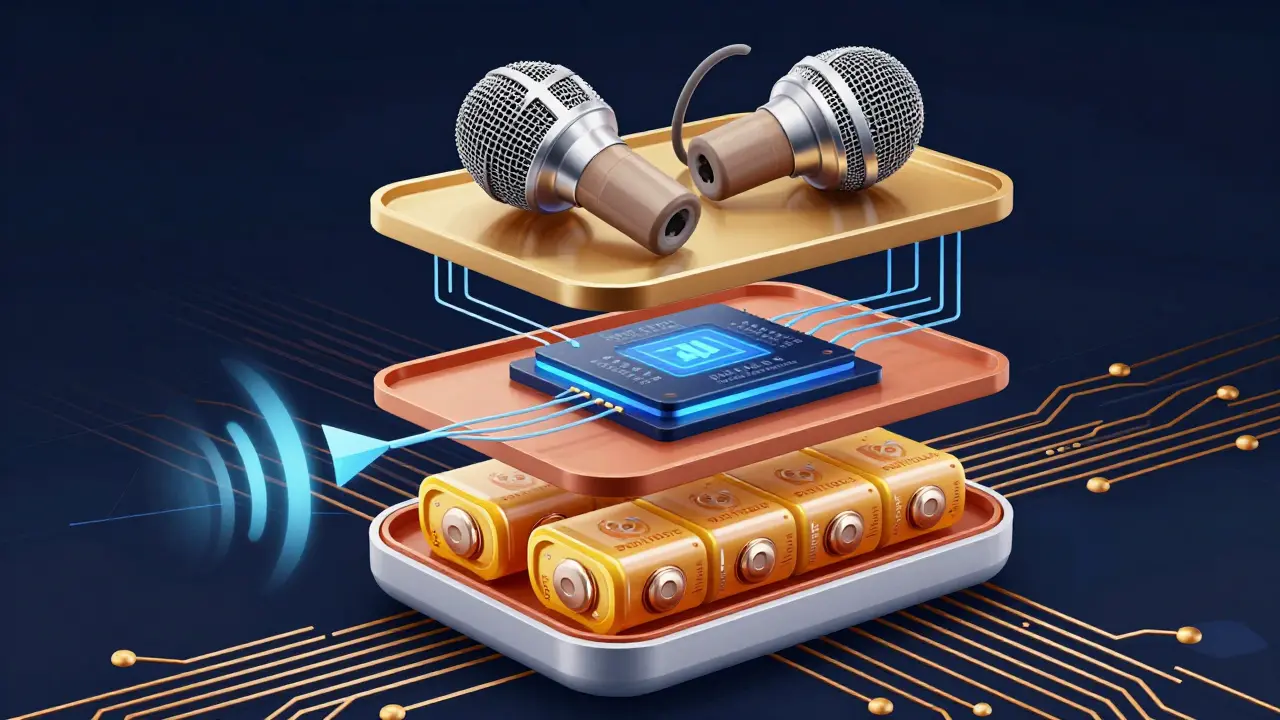
- Microphone Arrays: Most premium aids use multiple microphones. One points forward to catch speech, while others point sideways/backward to detect noise. The processor compares these inputs in real-time.
- Processing Channels: Sound is broken into frequency bands (channels). Budget aids might have 4 channels. Premium models, like the Starkey Edge AI, have 24 or more. More channels allow the aid to boost specific frequencies (like consonants s, t, f) without making background roar too loud.
- Latency Reduction: Delay is the enemy of hearing aids. If there’s a lag between seeing lips move and hearing the voice, your brain gets confused. New dual-chip architectures, such as those in the Phonak Audéo Infinio, reduce delay to 0.4 milliseconds. The industry average used to be 5-7 milliseconds. That difference feels instant.
AI plays a huge role now. Devices analyze hundreds of millions of data points per second to identify environments. Is it a restaurant? A windy park? A quiet library? The aid automatically switches programs. Some even offer real-time language translation or fall detection, blurring the line between hearing health and general wellness monitoring.
The Fitting Process: Why Self-Fitting Isn’t Always Easy
Buying the device is step one. Making it work is step two. This is where many people stumble.
For OTC Users: You will likely use a smartphone app. The process involves: 1. Inserting the aid. 2. Running a hearing test through the phone’s microphone. 3. Adjusting sliders for bass, treble, and volume based on how things sound. 4. Testing in different environments. This takes about 2.5 hours initially. While 85% of users succeed on the first try, the lack of professional guidance means you might miss subtle issues like tinnitus masking needs or directional mic optimization.
For Prescription Users: An audiologist performs a comprehensive audiogram. They map your hearing thresholds across frequencies. Then, they program the aid to match those thresholds precisely. This usually requires 3-4 appointments over 2-3 weeks. You’ll get follow-ups to tweak settings as your brain adapts-a process called auditory rehabilitation.
A critical part of fitting is managing the "occlusion effect." This is that hollow, booming sound you hear when chewing or walking with a hearing aid. It happens because the ear canal is blocked, trapping bone-conducted sound. Newer tech, like ReSound’s MAV (Microphone Acoustic Vent), reduces this effect by 45% by allowing air to escape through the vent while still blocking noise.
Cost and Value: What Should You Spend?
Pricing varies wildly depending on the care model. Here is a realistic breakdown for 2026:
- OTC Devices: $200 - $1,300 per pair. Example: Jabra Enhance Select 700 starts around $1,299. Great value for mild loss.
- Telehealth/Costco Models: $1,400 - $3,000 per pair. Example: Rexton Reach at Costco offers in-store support at mid-tier prices.
- Premium In-Clinic: $3,500 - $7,500+ per pair. Example: Phonak Audéo Infinio or Oticon Intent. You pay for expert fitting, ongoing adjustments, and top-tier tech.
Don’t just look at the sticker price. Consider the total cost of ownership. Do you need replacements every few months? Who fixes them when they break? OTC brands often provide chat support, resolving 92% of issues quickly. Prescription clinics offer personalized care but may charge for extra visits after the initial warranty period.
Maintenance and Daily Use Tips
Even the best hearing aid fails if you don’t care for it. Earwax is the number one enemy. According to the ASHA, 42% of users face monthly blockages. Here’s how to stay ahead:
- Clean Daily: Use the provided brush or pick to remove wax from the microphone ports and receiver dome. Do this every morning.
- Use a Dehumidifier: Sweat and humidity corrode circuits. Place your aids in a drying jar or electronic dehumidifier overnight. Silica gel packets work in a pinch during humid seasons.
- Check Batteries: Even rechargeable lithium-ion batteries degrade. If your runtime drops significantly, it’s time for a service check.
- Update Firmware: Like your phone, hearing aids get software updates. These often improve noise reduction and connectivity. Keep your companion app updated.
Also, give your brain time. If you haven’t worn aids before, start slow. Wear them for an hour at home, then increase gradually. Your brain needs to relearn how to filter background noise. This adaptation period typically lasts 2-4 weeks.
Future Trends: What’s Coming Next?
The hearing aid market is projected to reach $14.3 billion by 2029. Innovation is accelerating. We are seeing a shift toward health monitoring. Starkey’s roadmap includes blood oxygen sensing and fall detection. Connectivity is improving with LE Audio and Auracast, which allows broadcasting audio directly to your aids from TVs or public systems without headphones.
However, cybersecurity remains a concern. With Bluetooth enabled, there is a small risk of signal interception. Manufacturers are tightening encryption, but it’s something to keep in mind as these devices become more integrated into our digital lives.
Whether you choose an affordable OTC option or invest in premium prescription tech, the goal is the same: connection. Don’t let fear or complexity stop you. Start with a hearing test, explore your options, and take that first step back into clear conversation.
What is the difference between OTC and prescription hearing aids?
OTC hearing aids are sold directly to consumers for mild-to-moderate hearing loss without a medical exam. They are cheaper and self-fitted via apps. Prescription aids require an audiologist visit, offer higher power for severe loss, and include professional programming and follow-up care.
How long do hearing aid batteries last?
Rechargeable lithium-ion batteries typically last 24 to 30 hours on a single charge, depending on usage and features like Bluetooth streaming. Disposable zinc-air batteries last 3 to 7 days. Smaller styles like CIC may have shorter battery life (16-20 hours) due to size constraints.
Are hearing aids worth the money?
Yes. Untreated hearing loss is linked to cognitive decline, social isolation, and depression. Hearing aids improve communication, safety, and quality of life. While expensive, they are an investment in long-term health and independence.
Can I fix my hearing aids myself?
Minor issues like wax blockage or dead batteries can be fixed at home with cleaning tools. However, internal damage, moisture corrosion, or software glitches usually require professional repair. Most warranties cover manufacturing defects but not user damage.
Do hearing aids help with tinnitus?
Many modern hearing aids include tinnitus masking features. By amplifying ambient noise, they reduce the perception of ringing. Some devices also generate white noise or nature sounds specifically to soothe tinnitus symptoms.