
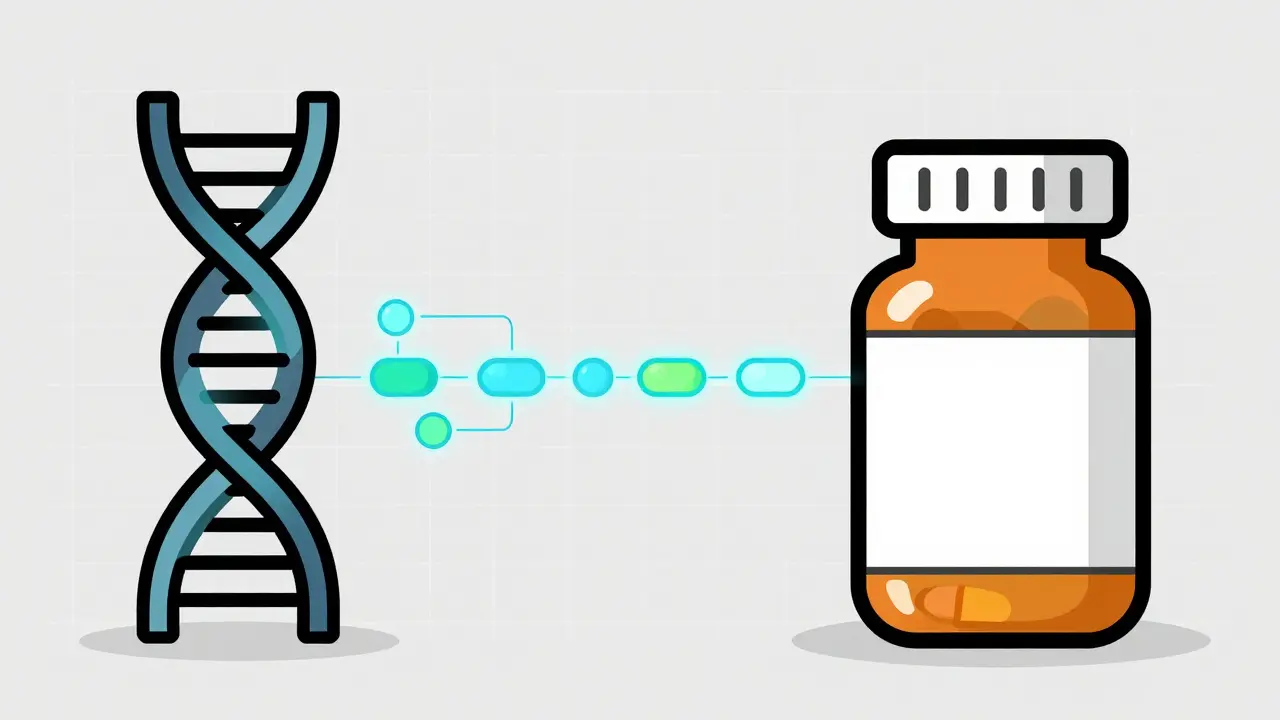
Have you ever taken a medication that worked wonders for your friend but left you feeling nauseous, dizzy, or worse? You aren't alone. For decades, doctors have relied on a 'trial-and-error' approach to prescribing drugs. We start with a standard dose, hope for the best, and adjust if side effects appear. But this method is risky. Adverse drug reactions (ADRs) are harmful responses to medications used at normal doses, and they account for approximately 7% of hospital admissions in countries like the UK, costing hundreds of millions annually in avoidable healthcare expenses. Imagine if we could predict these reactions before they happen. That is exactly what Pharmacogenetic testing is a precision medicine tool that analyzes genetic variants to predict how a patient will respond to specific medications. By looking at your DNA, this technology helps doctors choose the right drug and the right dose from day one, drastically reducing the risk of severe side effects.
How Pharmacogenetic Testing Works
At its core, pharmacogenetics is about understanding why your body processes drugs differently than someone else's. Your genes contain instructions for making proteins, including enzymes that break down medications. If you have a genetic variant that makes an enzyme work too slowly, a drug might build up in your system to toxic levels. Conversely, if your enzyme works too fast, the drug might be eliminated before it can do any good.
The technical implementation centers on specific gene-drug interaction panels that examine sets of germline variants associated with known drug metabolism and response pathways. In major clinical trials, researchers use panels that look at dozens of variants across key genes. These include:
- CYP2C19, CYP2C9, CYP2D6, CYP3A5: These cytochrome P450 enzymes are responsible for metabolizing a vast majority of prescribed medications, including antidepressants, painkillers, and heart drugs.
- SLCO1B1: This gene affects how statins (cholesterol-lowering drugs) are absorbed, influencing the risk of muscle pain.
- TPMT and DPYD: Crucial for patients undergoing chemotherapy or immunosuppressive therapy, as variants here can lead to life-threatening bone marrow suppression.
- HLA-B: Linked to severe skin reactions like Stevens-Johnson syndrome when taking certain anticonvulsants.
Modern genotyping arrays detect these variants with 99.9% accuracy. Once the sample is collected-usually via a simple cheek swab or blood draw-the results are integrated into electronic health records. The turnaround time has shrunk significantly, now ranging from 24 to 72 hours in many clinical settings. This speed allows doctors to make informed decisions quickly, especially in acute care scenarios.
The Evidence: What the PREPARE Study Revealed
Skeptics often ask if the science is solid enough for routine use. The answer lies in landmark research like the PREPARE study which is a multinational trial published in The Lancet demonstrating a 30% reduction in adverse drug reactions through preemptive pharmacogenomic testing. Conducted across seven European countries with nearly 7,000 participants, this was the first large-scale implementation of panel-based testing in real-world clinical practice.
The hypothesis was straightforward: if doctors guide drug and dose selection using genetic data, adverse events should drop. The results confirmed this, showing a 30% reduction in clinically relevant ADRs. Professor Sir Munir Pirmohamed, the principal researcher from the University of Liverpool, noted that this world-first demonstration proves ADRs can be drastically reduced when such testing is implemented. The study utilized a 12-gene panel examining 50 variants, proving that even a focused set of genes can impact more than 100 commonly prescribed medications.
Crucially, the study highlighted the superiority of preemptive testing-testing patients before they are prescribed high-risk drugs-over reactive testing, which happens only after a bad reaction occurs. Preemptive strategies cut ADRs by 30%, compared to just 15-20% with reactive approaches. This shift from reacting to preventing is a game-changer for patient safety.

Real-World Impact and Cost-Effectiveness
You might wonder if the benefits outweigh the costs. Pharmacogenetic testing typically ranges from $200 to $500 per panel in the United States. While this seems like an upfront expense, economic evaluations tell a different story. A systematic review of 59 studies found that 78% of implementations were cost-effective, yielding savings of $15,000 to $50,000 per quality-adjusted life year (QALY) gained. This is well below the conventional thresholds for healthcare interventions.
Consider the specific case of carbamazepine, a common anti-seizure medication. In Asian populations, the HLA-B*1502 genotype is strongly linked to Stevens-Johnson syndrome, a potentially fatal skin condition. Testing for this variant before prescription reduces the risk by 95%. Similarly, TPMT testing before azathioprine therapy decreases the risk of severe myelosuppression by 78%. Preventing these outcomes avoids costly hospitalizations, intensive care stays, and long-term disability.
| Feature | Standard Trial-and-Error | Pharmacogenetic-Guided |
|---|---|---|
| Approach | Reactive (after side effects occur) | Preemptive (before prescription) |
| ADR Reduction | Baseline risk | Up to 30% reduction |
| Time to Effective Drug | Weeks to months | Days (once results are available) |
| Hospitalization Risk | Higher (7% of admissions due to ADRs) | Lower (reduced emergency visits) |
| Initial Cost | $0 (but higher downstream costs) | $200-$500 per panel |
Challenges in Implementation
Despite the clear benefits, widespread adoption faces hurdles. One major issue is clinician confidence. Surveys indicate that only 37% of physicians feel confident interpreting pharmacogenetic results. Many doctors received little training in genetics during their residency. Dr. Richard Kim of Western University points out that addressing these knowledge gaps is critical for success.
Another challenge is workflow integration. About 42% of physicians report difficulties integrating test results into their daily routines. Electronic health record systems need robust Clinical Decision Support (CDS) alerts to notify prescribers when a patient’s genotype conflicts with a new prescription. Without these automated prompts, valuable genetic data can get lost in the noise of patient charts.
Polypharmacy also complicates things. When a patient takes multiple medications, the interactions between drug-gene pairs can create complex decision trees. An 'intermediate metabolizer' status for one drug might be fine, but combined with another inhibitor, it could become problematic. Guidelines from the Dutch Pharmacogenetics Working Group (DPWG) and the Clinical Pharmacogenetics Implementation Consortium (CPIC) help navigate these complexities, providing evidence-based recommendations for over 70 drug-gene pairs.

Who Should Consider Testing?
Not everyone needs pharmacogenetic testing immediately, but certain groups benefit most. Oncology leads adoption, with 65% of institutions using it, because chemotherapy drugs often have narrow therapeutic windows. Psychiatry follows closely at 52%, given the high rate of trial-and-error in treating depression and bipolar disorder. Primary care lags behind at 18% adoption, but this is changing as guidelines expand.
You should consider discussing testing with your doctor if:
- You have experienced severe side effects from medications in the past.
- You are starting treatment for cancer, epilepsy, or mental health conditions.
- You take multiple medications (polypharmacy), increasing interaction risks.
- Your family history includes unusual drug sensitivities.
Patient acceptance is high, with 85% of surveyed individuals willing to undergo preemptive testing if recommended by their physician. However, concerns about genetic privacy persist among about a third of potential users. It is essential to understand that pharmacogenetic data is protected under health privacy laws, similar to other medical records.
The Future of Personalized Medicine
The field is evolving rapidly. The global pharmacogenomics market is projected to reach $22.4 billion by 2028. Regulatory bodies are keeping pace; the FDA updated its Table of Pharmacogenetic Associations in March 2024 to include 329 gene-drug pairs. The European Commission has committed €150 million to support national implementation programs by 2027.
Future advancements focus on polygenic risk scores, which combine multiple genetic markers to predict drug response with 40-60% greater accuracy than single-gene tests. Additionally, point-of-care PCR-based testing aims to reduce costs to $50-$100 per panel by 2026, making this technology accessible to broader populations. As infrastructure improves and clinician education expands, pharmacogenetic testing will likely become a standard part of routine healthcare, turning the promise of personalized medicine into everyday reality.
Is pharmacogenetic testing covered by insurance?
Coverage varies by region and provider. In the United States, CMS covers testing for specific high-risk pairs like CYP2C19/clopidogrel and TPMT/thiopurines. Many private insurers also cover it for oncology and psychiatry indications. Always check with your insurer and provider beforehand.
How long does it take to get results?
In modern clinical implementations, processing time from sample collection to actionable report typically ranges from 24 to 72 hours. Some rapid point-of-care tests may provide results faster, but comprehensive panel analysis usually takes a few days.
Can I order pharmacogenetic testing online?
While direct-to-consumer kits exist, clinical-grade testing ordered through a healthcare provider is recommended. Provider-ordered tests ensure proper interpretation, integration with your electronic health record, and access to clinical decision support tools that guide safe prescribing.
Does the test change every time I take a new drug?
No. Your genetic makeup does not change. Preemptive testing provides a lifetime profile of your metabolic capabilities. Doctors refer back to these results whenever prescribing new medications, eliminating the need for repeated testing.
What if I am an intermediate metabolizer?
Intermediate metabolizers process drugs slower than normal but faster than poor metabolizers. This often requires dose adjustments rather than avoiding the drug entirely. Guidelines from CPIC and DPWG provide specific dosing recommendations for each gene-drug pair based on metabolizer status.






12 Comments