
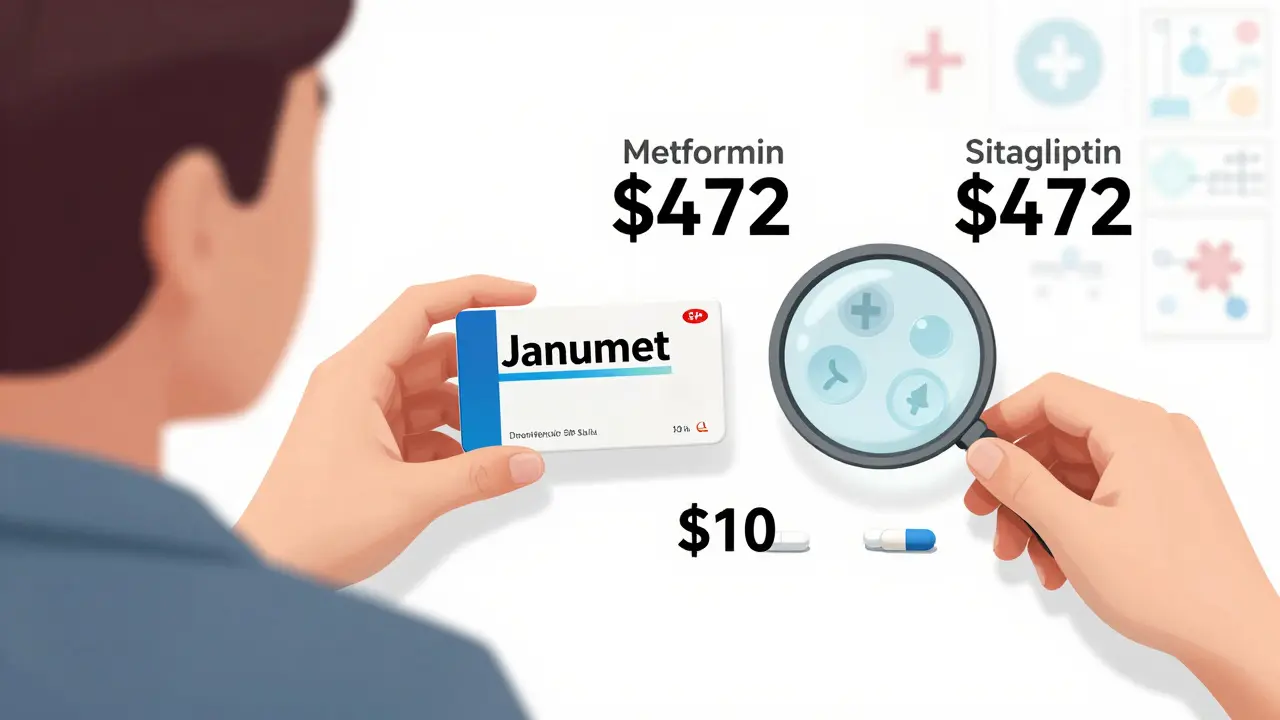
When you’re on multiple medications for conditions like high blood pressure, diabetes, or heart failure, your doctor might prescribe a combo generic - a single pill that combines two or more drugs. It sounds convenient. Fewer pills to manage. Easier to remember. But here’s the real question: Are you paying way more than you need to?
In 2016, Medicare Part D spent $925 million more on 29 branded combination drugs than it would have if patients had simply bought the generic versions of each individual component separately. That’s not a typo. Nearly a billion dollars wasted because of how these pills are priced. And it’s not just Medicare. Patients everywhere are overpaying - often by 10 to 15 times - for what should be simple, cheap medications.
How Combo Drugs Are Priced (And Why It Doesn’t Make Sense)
Fixed-dose combinations (FDCs) aren’t inherently bad. They’re designed to improve adherence - meaning people are more likely to take their meds if they only have to swallow one pill instead of three. But pricing? That’s where things get shady.
Let’s say you need two drugs: one for blood pressure and one for cholesterol. Each is available as a generic. The blood pressure pill costs $4 a month. The cholesterol pill? $6. Together, that’s $10. But if a drug company packages them into a single branded combo, they might charge you $472 a month. That’s what happened with Janumet - a combo of sitagliptin and metformin. Metformin, one of the cheapest drugs on the planet, runs $4 at Walmart. Yet the combo? Nearly $500. Why? Because the manufacturer holds a patent on sitagliptin and uses the generic metformin as a free ride.
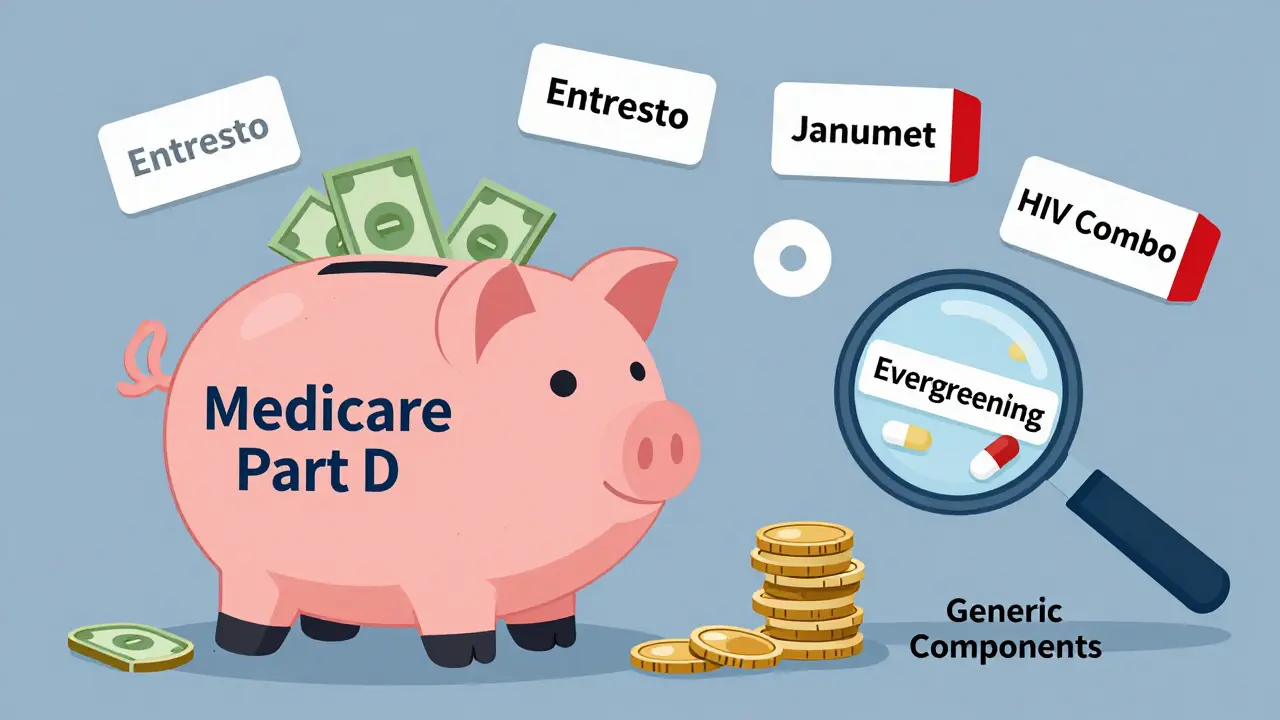
This isn’t innovation. It’s called evergreening. Drugmakers take an old, off-patent drug, slap it with a new, expensive one, and call it a breakthrough. The FDA doesn’t stop them. Insurance plans often don’t challenge them. And patients? They just assume the combo is worth the price.
The Math Doesn’t Add Up
Here’s the hard truth: combo generics almost never cost less than buying the parts separately - even when both components are generic.
IQVIA’s 2022 analysis found that branded FDCs typically cost 60% of what two separate branded drugs would cost. Sounds good, right? But when you switch to generics? The math flips. The sum of two generic components can be 80-85% cheaper than the branded combo. That means:
- Branded combo: $472/month
- Generic metformin + generic valsartan: $15/month
- Savings: $457/month - or over $5,500 a year
For Entresto (sacubitril/valsartan), the branded combo cost Medicare $1.4 billion in 2016. If patients had taken generic valsartan and the brand-name sacubitril separately, the cost would’ve dropped by 73.5%. That’s not just a saving - it’s a systemic failure.
And it’s not just diabetes or heart drugs. The same pattern shows up in HIV meds, asthma inhalers, and even mental health combinations. One study found that patients on combo HIV pills were 15-20% more likely to stick with treatment. But that doesn’t mean they should pay 10 times more. There’s a better way.
Who’s Paying the Price?
You are. Your insurance is. Your tax dollars are.
Medicare Part D paid 22-33% more for brand-name drugs than the Department of Veterans Affairs for the exact same medications. Why? Because Medicare can’t negotiate prices the way the VA can. And combo drugs? They’re the worst offenders. In 2021, combo drugs made up just 2.1% of all prescriptions filled - but accounted for 8.3% of total spending. That’s a massive imbalance.
Pharmacy benefit managers (PBMs) know this. That’s why 62% of Medicare Part D plans now require prior authorization for high-cost combos. Some even block them entirely and push doctors to prescribe separate generics. The University of Michigan Health System found that switching patients from branded combos to individual generics saved an average of $1,200 per patient per year. That’s not a small number - that’s life-changing for someone on a fixed income.
When Does a Combo Actually Make Sense?
Not all combos are scams. There are real cases where they help.
Take patients with multiple chronic conditions - say, diabetes, kidney disease, and high blood pressure. If someone is taking five pills a day, a well-designed combo can reduce that to two. Adherence goes up. Hospital visits go down. That’s clinical value.
But here’s the catch: The combo needs to be priced fairly. If the individual components are already generic, the combo should cost no more than the sum of those generics - plus a tiny premium for convenience. Instead, manufacturers price them like brand-new drugs. That’s not value. That’s exploitation.
The American College of Cardiology says FDCs can improve adherence by 25% in complex cases. But they also say: don’t let cost be a barrier. If a patient can’t afford the combo, they’ll skip doses. And that’s worse than taking separate pills.
What You Can Do Right Now
You don’t have to accept this. Here’s how to take control:
- Ask your pharmacist: "Are these drugs available as separate generics?" If yes, ask if you can split them.
- Check prices: Use GoodRx or RxSaver. Compare the combo price to the sum of the individual generics. If the combo costs more than twice the sum, you’re overpaying.
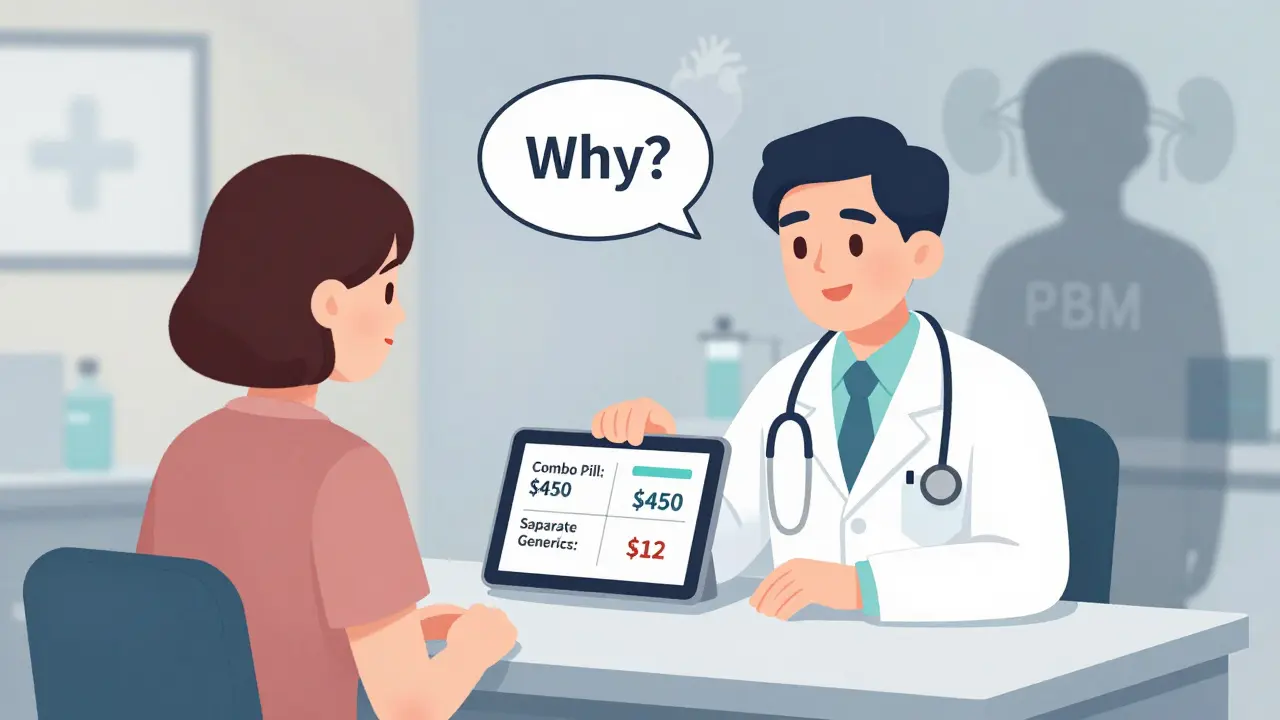
- Talk to your doctor: Say, "I’ve been paying $450/month for this combo. The generic versions cost $12. Can we switch?" Most doctors are unaware of the price gap.
- Use mail-order pharmacies: They often have better generic pricing than local stores.
- Ask about manufacturer coupons: Some companies offer co-pay cards - but these are temporary. They don’t fix the system.
One woman in Wisconsin switched from a branded combo for hypertension to generic amlodipine and hydrochlorothiazide. Her monthly cost dropped from $380 to $8. That’s not a win. That’s justice.
What’s Changing?
The Inflation Reduction Act of 2022 lets Medicare negotiate prices for high-cost drugs - including combos. That’s huge. The FDA is also speeding up approval of generic versions of individual components. And more insurers are creating "preferred generic" policies that make combos harder to get unless there’s a real clinical reason.
But change is slow. Until then, you have power. You can choose. You can question. You can save.
Don’t assume a combo is better just because it’s one pill. Ask the numbers. Compare the cost. Demand transparency. Your wallet - and your health - will thank you.







10 Comments