

Reporting a safety violation, financial fraud, or unethical practice at work isn’t just brave-it’s often your legal right. But knowing you can report doesn’t mean you’re protected. Too many people stay silent because they’ve seen coworkers get pushed out, demoted, or fired after speaking up. The truth? Whistleblower laws exist, but they’re not simple, and they’re not the same everywhere.
What Counts as Protected Reporting?
You don’t need proof to report. You just need a reasonable belief that something illegal or dangerous is happening. Under California’s Labor Code Section 1102.5, if you think your employer is breaking state or federal law-whether it’s falsifying safety records, hiding environmental violations, or covering up patient neglect-you’re protected. That includes telling your manager, calling a government agency, or even filing a complaint with OSHA. It’s not just current employees. Job applicants, former workers, and even people who are just thought to be planning to report are covered. If your boss finds out you’re thinking about blowing the whistle and starts treating you differently-cutting your hours, giving you impossible deadlines, or excluding you from meetings-that’s retaliation, and it’s illegal.What Retaliation Looks Like (And How It’s Hidden)
Retaliation doesn’t always come with a termination letter. More often, it’s quiet, slow, and designed to make you quit. - You’re moved to a graveyard shift after reporting an OSHA violation.- Your performance reviews suddenly drop, even though your work hasn’t changed.
- You’re denied promotions or training opportunities you’ve earned.
- Colleagues are told to avoid you.
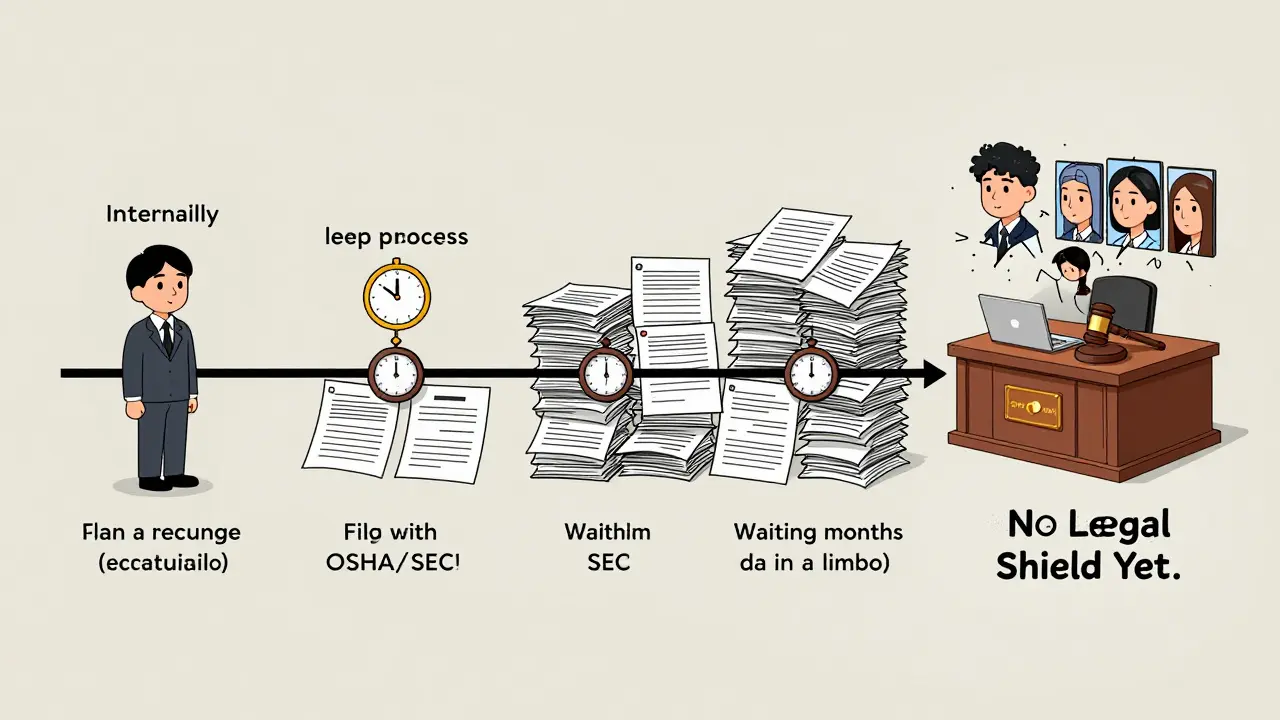
- You’re blamed for problems you didn’t cause. In 2024, a nurse in California was fired after reporting that her hospital was cutting corners on infection control. She won her case-and got $287,000 in back pay. But she spent 22 months fighting it. That’s the average time a whistleblower case takes in California, according to the Division of Labor Standards Enforcement. Most people can’t afford to wait that long without income.
Federal vs. California: Which Protections Are Stronger?
California’s laws are among the strongest in the country. Starting January 1, 2025, every employer in the state must post a clear, 14-point font notice about whistleblower rights-including the Attorney General’s hotline (1-800-952-5225)-in a visible workplace area. Failure to do so can cost them up to $10,000 per violation. Federal laws are more scattered. OSHA enforces 25 different whistleblower statutes, each with different rules. For example:- Under the Clean Air Act, you have 30 days to file a complaint.
- Under the Consumer Financial Protection Act, you have 180 days.
- The Sarbanes-Oxley Act protects people who report fraud by public companies.
- The False Claims Act rewards whistleblowers who expose fraud against government programs.
Financial Incentives: When Reporting Pays Off
Some whistleblower laws don’t just protect you-they pay you. The Dodd-Frank Act gives financial rewards to people who report securities fraud to the SEC. If your information leads to a successful case with penalties over $1 million, you can get 10% to 30% of the money recovered. In fiscal year 2023, the SEC paid out $637 million to 131 whistleblowers-a 27% jump from the year before. That’s not just about justice. It’s a signal: the government is betting big on insiders to catch fraud. But here’s the catch: you usually need to go outside your company first. If you report internally and then to the SEC within 120 days, you’re still eligible. But if you only report internally, you won’t qualify for the reward.The Hidden Gaps: Where the System Still Fails
Even with strong laws, enforcement is inconsistent. A 2024 survey by the National Whistleblower Center found that 68% of whistleblowers still faced some form of retaliation. Why? HR departments often don’t know the law. In October 2024, 65% of small business owners in California hadn’t heard about the new 2025 posting requirement. Managers might not realize that shifting someone’s schedule after a report counts as retaliation. OSHA, the agency meant to enforce these rules, regularly misses deadlines. In 2024, they failed to complete 63% of required investigations within the legal 90-day window. That means complaints sit for months while whistleblowers lose income and face mounting stress. And then there’s the AI loophole. In May 2025, Senator Grassley introduced the AI Whistleblower Protection Act. Why? Because tech employees who report biased algorithms, dangerous AI experiments, or hidden data misuse have no legal shield. Right now, if you’re fired for exposing that your company’s AI is discriminating against job applicants, you’re out of luck.
What You Should Do Before Reporting
Don’t go in blind. Here’s what actually works:- Document everything. Save emails, texts, performance reviews, shift schedules. If you’re moved to a night shift after reporting, write down the date and who told you.
- Know your deadline. Federal claims have tight windows-30 to 180 days depending on the law. Miss it, and you lose your right to file.
- Use the right channel. For California violations, contact the Labor Commissioner. For federal issues like environmental or financial fraud, file with OSHA or the SEC.
- Call a lawyer. The National Whistleblower Center says 78% of successful cases involved legal help. Many offer free initial consultations.
- Know your resources. California’s Whistleblower Hotline: 1-800-952-5225. OSHA: 800-321-6742. The National Whistleblower Center offers free support to whistleblowers.





15 Comments