
Atopic dermatitis isn’t just dry skin. It’s a stubborn, recurring condition where your skin barrier breaks down, letting irritants in and moisture out. The itch starts, you scratch, and the cycle gets worse. No matter how hard you try to ignore it, the flare-ups keep coming. But here’s the truth: most flares aren’t random. They’re triggered by things you can control - and the most powerful tool to stop them isn’t a steroid cream. It’s emollient therapy.
What Really Causes Your Eczema Flares?
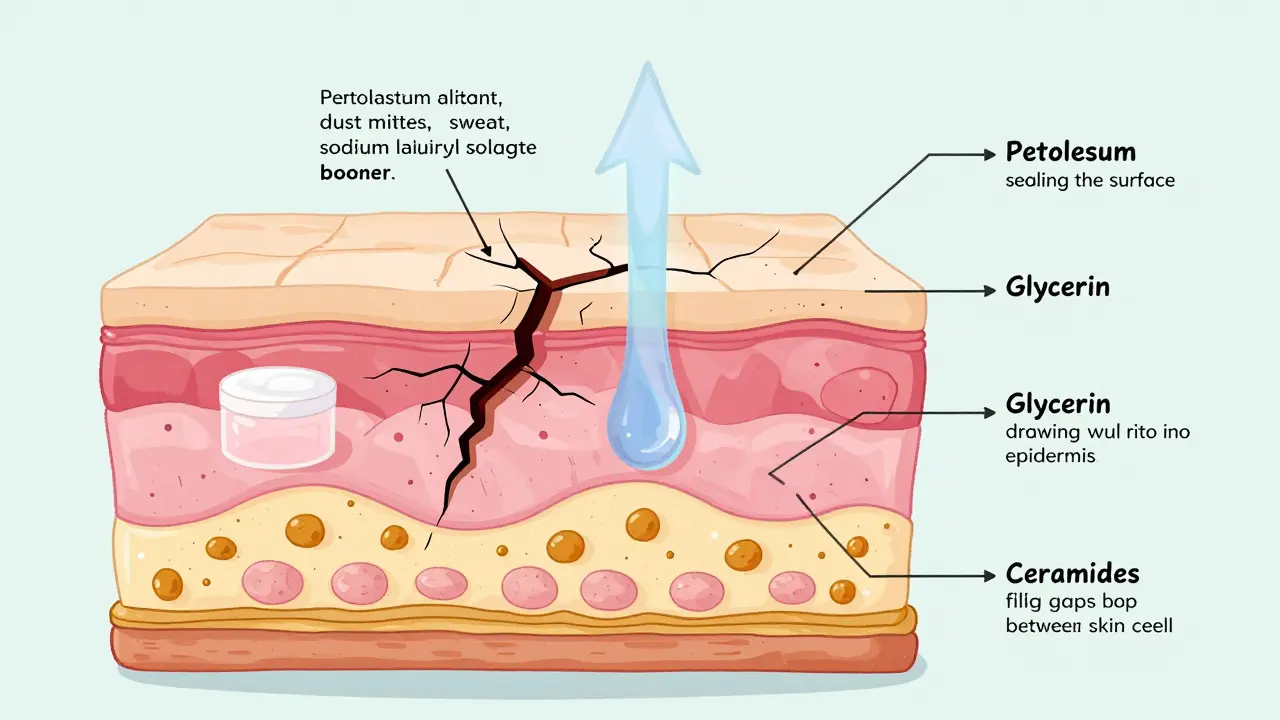
Atopic dermatitis flares don’t happen out of nowhere. They’re usually kicked off by one or more triggers that exploit a weakened skin barrier. The most common culprits are environmental and everyday products you might not even think about.Cold, dry air is a major offender. When humidity drops below 40%, your skin loses moisture 37% faster. That’s why winter is brutal for so many people. But heat is just as bad. Sweat from temperatures above 80°F (27°C) irritates the skin in nearly 7 out of 10 patients. The salt and chemicals in sweat get trapped in cracks in the skin, making itching worse.
Then there’s what you put on your skin. Sodium lauryl sulfate - a common ingredient in soaps and shampoos - can wreck your barrier at concentrations as low as 0.5%. Fragrances? They’re in about 15% of products that make flares worse. Even preservatives like methylisothiazolinone, found in some moisturizers, trigger contact dermatitis in over 5% of users.
Washing habits matter too. Long, hot showers strip natural oils. Skipping moisturizer after bathing? That’s like leaving a wound open to the air. And let’s not forget stress, dust mites, and pet dander. These don’t cause eczema, but they can turn a quiet patch into a full-blown flare.
Emollients: The Foundation of Every Treatment Plan
The American Academy of Dermatology says emollients are the #1 first-line treatment for atopic dermatitis. Why? Because they fix the root problem: a broken skin barrier.Emollients aren’t just moisturizers. They’re barrier repair agents. They work in three ways:
- Occlusives (like petrolatum) form a seal over the skin to trap moisture. Petrolatum reduces water loss by up to 98%.
- Humectants (like glycerin) pull water into the skin. The sweet spot? 40-50% concentration. Too little does nothing. Too much can dry skin out.
- Emollients (like ceramides) fill the gaps between skin cells. Ceramides make up 50% of your skin’s natural barrier. In atopic dermatitis, levels drop by up to 70%. Replacing them is key.
Studies show consistent emollient use cuts flares by 36% over six months. That’s not a small win - it’s life-changing. Patients who use over 100 grams of emollient per week have 43% fewer flares than those who use less than 50 grams. The dose matters.
How to Apply Emollients Right - The Soak and Seal Method
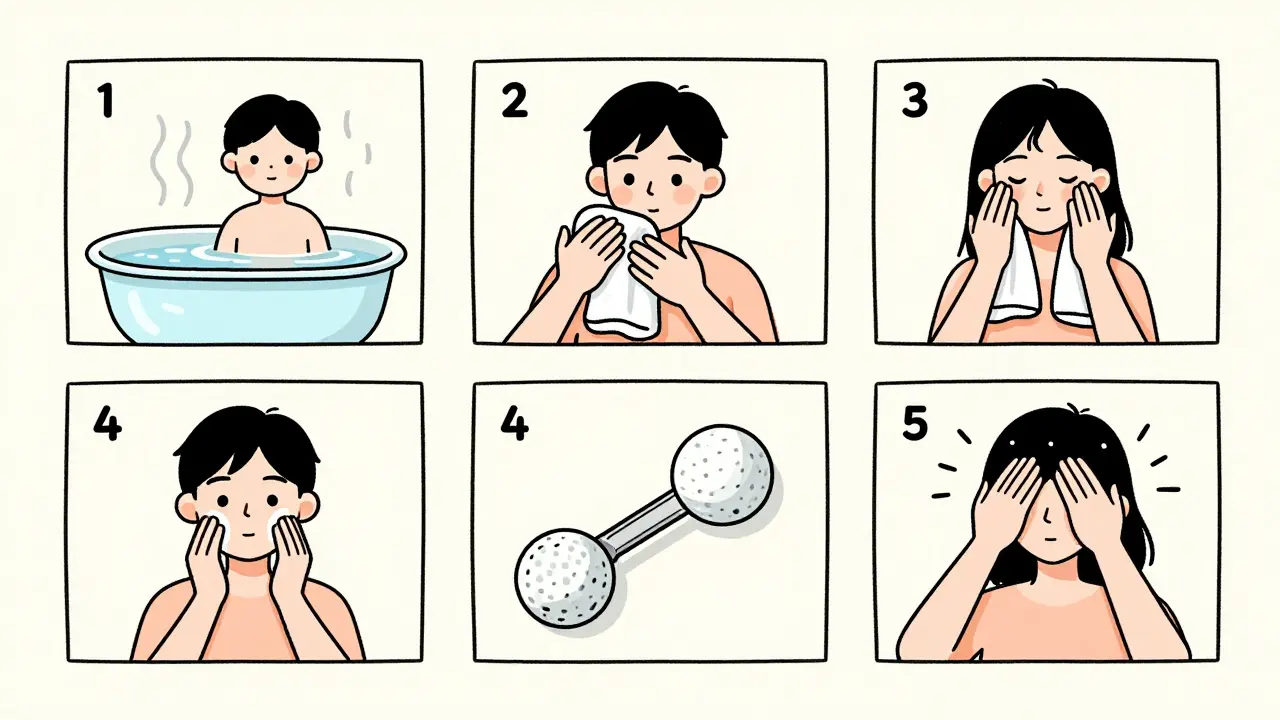
Applying emollient randomly won’t cut it. You need a routine. The gold standard? The “soak and seal” method.- Take a 15-20 minute lukewarm bath (no hot water). No harsh soaps - just water or a gentle cleanser.
- Pat your skin dry - don’t rub.
- Within 3 minutes, apply your emollient. This locks in 50% more moisture than applying later.
- Use enough. Adults need 250-500 grams per week. That’s about a golf ball-sized amount per body part. For kids, double that.
- Apply in downward strokes, following hair growth. Rubbing in circles can irritate.
Most people apply emollients once a day. But twice-daily use is what delivers results. The problem? Only 22% of patients manage it. Time and texture are the biggest barriers. If your cream feels greasy or sticky, you’re not alone. But there are better options.
Which Emollients Actually Work? Brands, Ingredients, and Real-World Results
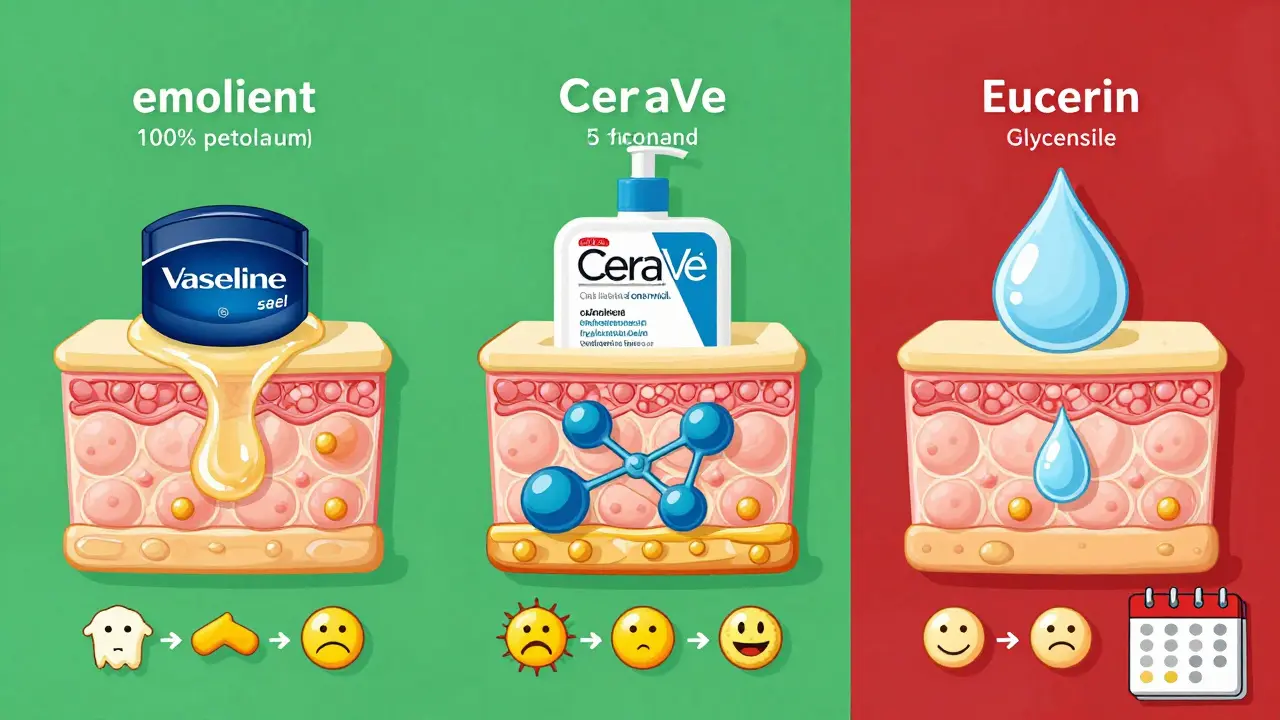
Not all moisturizers are created equal. Here’s what the data says about top performers:| Product Type | Key Ingredients | Effectiveness | Cost (Avg. per tube) | Common Complaints |
|---|---|---|---|---|
| Petrolatum (Vaseline) | 100% petrolatum | 98% TEWL reduction | $8.49 | Too greasy for some |
| CeraVe | Ceramides, hyaluronic acid | 68% patient satisfaction | $14.99 | Thick texture |
| Eucerin | Ceramides, glycerin | 52% patient satisfaction | $16.99 | Some report stickiness |
| Urea-based creams | 5-10% urea | Good for thick skin | $12.99 | 42% find it sticky |
| Preservative-free options | Minimal additives | Best for sensitive skin | $20-$30 | Expensive, hard to find |
Reddit users with over 145,000 members overwhelmingly prefer fragrance-free, ceramide-rich formulas. Vaseline topped the list for severe flares. CeraVe scored higher satisfaction than Eucerin. But cost is a real issue. A tube of ceramide cream can cost over $18, while petrolatum is under $9.
Here’s the catch: if your emollient has parabens, methylisothiazolinone, or fragrance, it might be making things worse. Look for labels that say “fragrance-free,” “non-comedogenic,” and “dermatologist-tested.”
When Emollients Alone Aren’t Enough
Emollients work best for mild cases and maintenance. But if you’re in the middle of a bad flare, they won’t fix it alone.For moderate to severe eczema, you’ll likely need a short course of topical corticosteroids or calcineurin inhibitors like tacrolimus. These calm inflammation fast. But they’re not meant for long-term daily use - especially on the face or folds.
For chronic, severe cases, newer biologics like dupilumab reduce flares by 70-80%. But even these rely on emollients to keep the skin stable. Without barrier repair, these drugs lose effectiveness.
And here’s something surprising: using emollients from birth only cuts eczema risk by 11% in high-risk babies. That’s far less than earlier studies suggested. So while emollients help, they’re not a magic shield.
The Hidden Problem: Why People Stop Using Emollients
The biggest failure in atopic dermatitis care? Adherence. Only 35% of patients still use emollients consistently after six months.Why? Three reasons:
- Texture - Greasy, sticky, or heavy creams feel unpleasant. Some people hate the residue.
- Time - Applying twice daily feels like a chore. Parents of kids with eczema say they’re too tired to keep up.
- Cost - Prescription-grade emollients add up. $20-$40 a month isn’t trivial.
Dr. Emma Guttman-Yassky found that 30% of patients quit because the product “feels gross.” The fix? Try different formulations. A lighter lotion might work better than a thick ointment. A pump bottle might be easier than a jar. Experiment until you find one you don’t mind using.
Also, don’t assume you need to buy expensive brands. Petrolatum is cheap, effective, and widely available. It’s not glamorous, but it works.
What’s Next? The Future of Emollient Therapy
New developments are changing the game. In May 2023, the FDA approved the first emollient with sustained-release ceramides. It keeps working for 12 hours - longer than traditional formulas. Smart dispensers that track usage are being tested in hospitals. And researchers are developing emollients tailored to your skin’s microbiome - the bacteria living on your skin.But none of this replaces the basics. No matter how advanced the science gets, the core rule stays the same: repair the barrier. Prevent the itch. Stop the scratch.
Atopic dermatitis isn’t cured by one miracle product. It’s managed by consistent, smart habits. And emollient therapy? It’s the only treatment that’s safe, effective, and essential for everyone - from babies to adults.
Can I use regular lotion for atopic dermatitis?
Most regular lotions contain fragrances, alcohol, or harsh preservatives that can irritate eczema-prone skin. Look for products labeled fragrance-free, non-comedogenic, and with ceramides or petrolatum. Avoid anything that stings when applied. If it doesn’t say "for eczema" or "dermatologist-recommended," it’s probably not the best choice.
How much emollient should I use each time?
Use about 2-3 finger units per body area - like one arm, one leg, or your chest. A finger unit is the amount squeezed from a tube along the length of an adult’s index finger. Adults need 250-500 grams per week. That’s roughly 1-2 tubes a month. Kids need double that. Don’t skimp - underuse is why most people don’t see improvement.
Should I apply emollient before or after steroid cream?
Apply steroid cream first, then wait 15-30 minutes before applying emollient. This lets the medication absorb properly. Emollients applied too soon can block absorption. After the steroid wears off, emollient helps maintain the healing. Never mix them in the same application.
Is petroleum jelly safe for babies with eczema?
Yes. Pure petrolatum (like Vaseline) is one of the safest options for babies. It’s inert, non-allergenic, and highly effective at sealing in moisture. Use it after baths or on dry patches. Avoid anything with additives - stick to 100% petroleum jelly. It’s cheap, effective, and approved by pediatric dermatologists.
Why does my skin get worse even though I use emollient every day?
You might be using the wrong product. Check the ingredients. Are there fragrances, parabens, or sodium lauryl sulfate? Even if it’s labeled "moisturizer," those ingredients can trigger flares. Also, are you applying it within 3 minutes after bathing? If you wait longer, you lose half the benefit. And are you using enough? Most people use too little. Try switching to a ceramide-based formula and increase your weekly amount to at least 250 grams.







16 Comments