
When you hear "retinoid," you might think of expensive skincare routines or dermatologist visits. But the truth is, tretinoin and adapalene are two of the most effective, well-researched tools we have for fixing two of the most common skin problems: acne and aging. And they work in different, but equally powerful, ways.
What Exactly Are Tretinoin and Adapalene?
Tretinoin is the original retinoid. It’s a form of vitamin A that’s been used since the 1970s to treat acne and sun damage. It’s prescription-only and comes in strengths from 0.01% to 0.1%. Adapalene, on the other hand, is newer. Developed in the 1990s and made available over-the-counter in 2016, it’s now sold as Differin Gel. It’s a synthetic retinoid, meaning it’s made in a lab to mimic how natural vitamin A works - but with less irritation.
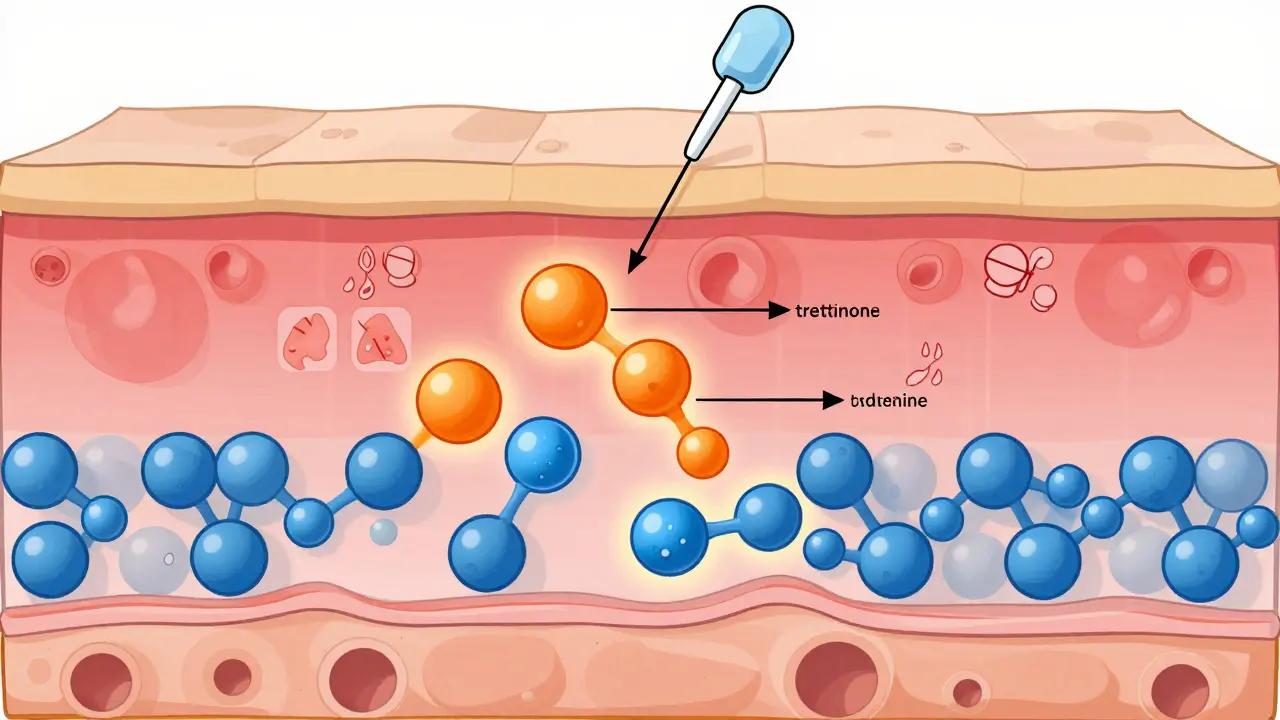
Both work by speeding up how fast your skin cells turn over. Think of it like a reset button for your skin. Instead of dead cells piling up and clogging pores, they slough off faster. This clears acne before it forms. It also helps fade dark spots, smooth fine lines, and thicken the deeper layers of skin over time.
How They Work Differently
Here’s the key difference: tretinoin goes deeper. It works on both the top layer of skin (epidermis) and the layer below (dermis). That’s why it’s better for wrinkles, sunspots, and thick, rough skin. Adapalene mostly stays in the epidermis. It’s great at unclogging pores and calming inflammation, but it doesn’t rebuild collagen like tretinoin does.
Chemically, tretinoin is unstable. It breaks down in sunlight and air. That’s why it’s usually packaged in opaque tubes and applied at night. Adapalene? It’s stable. You can leave it out on the counter. It even works well with benzoyl peroxide - something tretinoin can’t handle without losing its power.
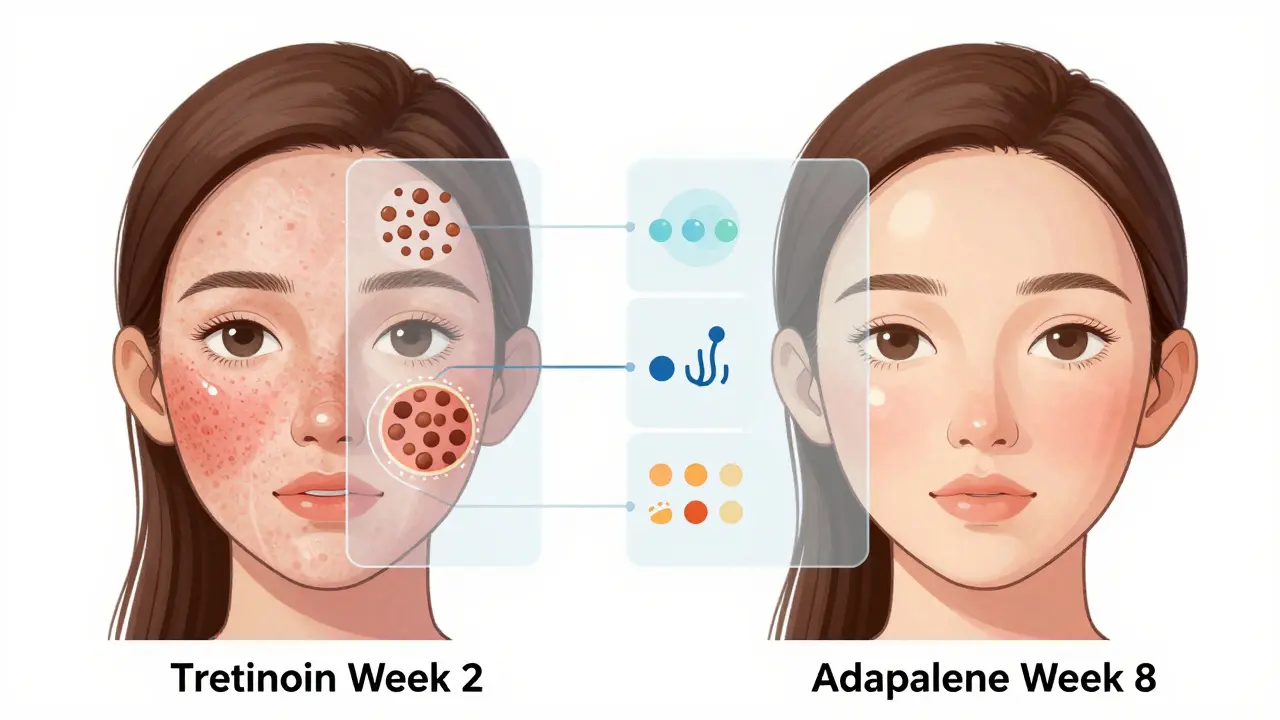
Studies show tretinoin 0.05% improves fine wrinkles by 42% after 24 weeks. Adapalene 0.3%? It gets you about 35%. For acne, they’re almost even. Adapalene 0.1% reduces acne lesions by 70% in 8 weeks. Tretinoin 0.025% does the same. But here’s the catch: adapalene causes way less irritation.
Which One Causes Less Irritation?
If you’ve ever had red, peeling, burning skin after starting a retinoid, you’re not alone. Nearly 90% of people using tretinoin feel some level of irritation in the first few weeks. With adapalene? Only about 60%. A 2002 study of 150 Chinese patients found adapalene users had irritation scores of 2.1 out of 10. Tretinoin users? 3.4.
That’s why most dermatologists recommend starting with adapalene - especially if you have sensitive skin, dry skin, or have never used a retinoid before. You can build up your skin’s tolerance without the panic of flaking like you’ve been sandblasted.
And if you’re someone who’s tried tretinoin and quit because your skin felt raw? You’re not weak. You just picked the wrong entry point. Many people switch from tretinoin to adapalene, get their skin stable, and then go back to tretinoin - this time with better results.
Real User Experiences
On Reddit’s r/SkincareAddiction, one user wrote: "I started with tretinoin 0.025% and had to stop after two weeks. My face was raw. Switched to Differin. After eight weeks, my skin is clear. I only get dry twice a week. No more burning."
Another user on Amazon said: "Differin cleared my acne. But my wrinkles? Still there. I switched to Retin-A Micro. After five months, I saw lines soften. My mom asked if I got a facial."
These aren’t isolated stories. Across 1,247 user reviews, 68% preferred adapalene for starting out. But among people over 35 focused on aging, 71% stuck with tretinoin.
The biggest reason people quit? They expect instant results. But retinoids don’t work like a magic cream. They need 8 to 12 weeks just to show changes. Real improvement? That’s 6 to 12 months. Most users who stick it out see 87% improvement.
How to Use Them Right
Here’s the simple routine that works for most people:
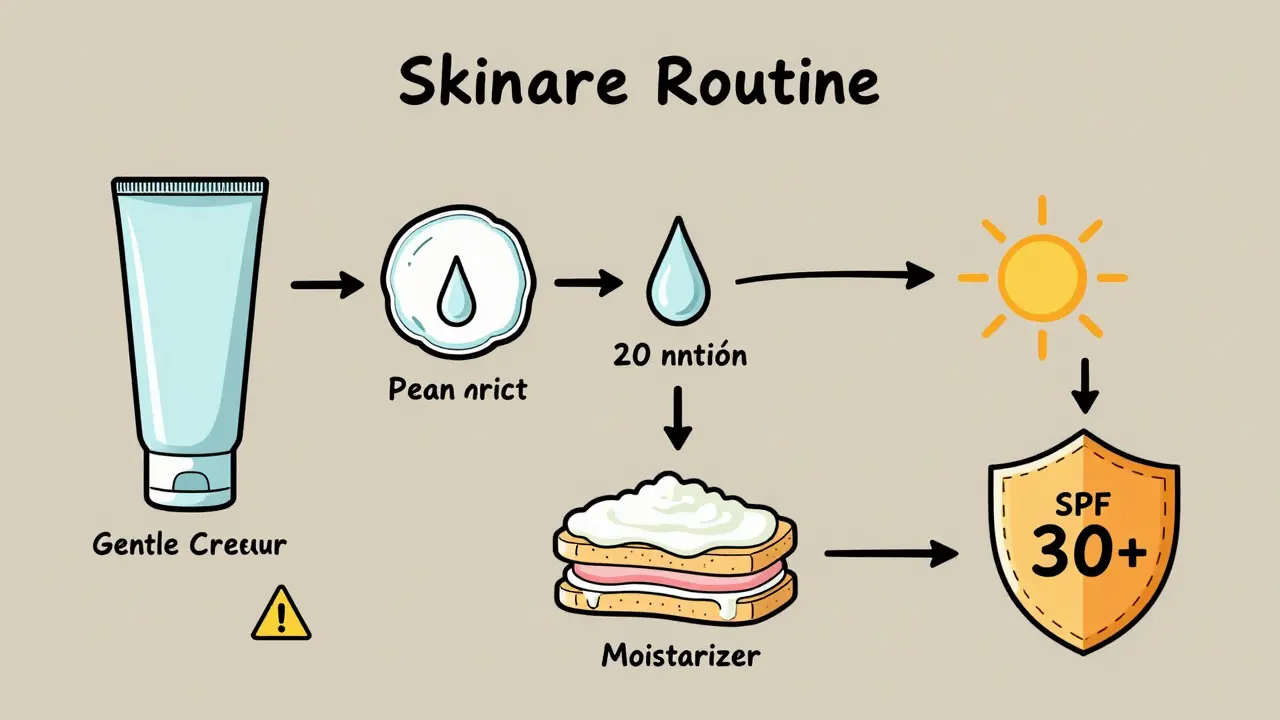
- Wash your face with a gentle cleanser. Let it dry completely.
- Wait 20 minutes. Yes, really. Wet skin = more irritation.
- Use a pea-sized amount for your whole face. More doesn’t mean better.
- Apply it 2-3 nights a week. Don’t go daily at first.
- Follow with moisturizer. Try the "sandwich method": moisturizer → retinoid → moisturizer.
- Wear SPF 30+ every single morning. No exceptions. Retinoids make you burn easier.
That’s it. No fancy serums. No layering five products. Just consistency.
And if your skin feels tight or flaky? That’s normal. It’s called "retinization." It’s not an allergic reaction. It’s your skin adjusting. Most of the time, it fades after 4-6 weeks.
Cost, Availability, and What’s New
Adapalene 0.1% (Differin Gel) costs about $15 over-the-counter. Tretinoin? Prescription only. Without insurance, it’s $45+ per tube. With insurance? Often $10-$20. That’s why adapalene is the #1 dermatologist-recommended acne treatment in 2023.
Newer versions are making tretinoin easier to use. Altreno (0.05% tretinoin lotion) came out in 2022. It causes 35% less irritation than old-school tretinoin creams. And Epiduo - a combo of adapalene and benzoyl peroxide - clears 81% of acne in 12 weeks. That’s better than either alone.
Who Should Use What?
Here’s a quick guide:
- Start with adapalene if: You’re new to retinoids, have sensitive skin, or just want to clear acne.
- Choose tretinoin if: You’re over 35, have sun damage, deep wrinkles, or stubborn dark spots.
- Try a combo: Use adapalene at night, tretinoin twice a week. Or try Epiduo if acne is your main issue.
There’s no "best." Only best for you.
What About Other Retinoids?
There are others - like tazarotene (Tazorac). It’s stronger than tretinoin for acne, but it’s harsher too. Most people don’t need it. Tretinoin and adapalene have over 50 years of safety data. That’s why dermatologists keep coming back to them.
Future treatments might use genetic testing to predict who responds best to which retinoid. But for now? The old-school tools still win.
Final Thoughts
Retinoid therapy isn’t glamorous. It’s not a quick fix. But if you want skin that’s clearer, smoother, and younger-looking, nothing else comes close. Tretinoin and adapalene aren’t magic. They’re science. And they work - if you give them time.
Start low. Go slow. Be patient. Use sunscreen. And don’t quit after two weeks. That’s when most people give up - right before the magic starts.
Can I use adapalene and tretinoin together?
No, you shouldn’t use them together. Both are retinoids, and using them at the same time increases irritation without adding benefits. Stick to one. If you want more power, switch from adapalene to tretinoin after your skin adjusts. Or use a combo product like Epiduo, which pairs adapalene with benzoyl peroxide.
How long until I see results?
You’ll start noticing changes around week 8. Acne will begin to clear, and skin texture will feel smoother. For wrinkles and dark spots, it takes 3-6 months. Real transformation - the kind people notice - takes 6 to 12 months. Patience is the most important ingredient.
Why does my skin get worse before it gets better?
That’s called "purging." Retinoids speed up cell turnover, which brings clogged pores to the surface faster. You might get more breakouts for 2-4 weeks. This isn’t an allergic reaction - it’s your skin cleaning house. If it lasts longer than 6 weeks, you might be using too much or too often. Cut back and give it time.
Can I use retinoids if I’m pregnant?
No. Both tretinoin and adapalene are Category C, meaning they can affect fetal development. If you’re trying to get pregnant or think you might be, stop using them immediately and talk to your doctor. There are safer alternatives for acne during pregnancy.
Do I need to use sunscreen every day?
Yes. Every single day. Retinoids make your skin more sensitive to UV light. Without sunscreen, you risk sunburn, dark spots, and even long-term damage that cancels out the benefits. SPF 30 or higher, broad-spectrum, non-negotiable.
Is adapalene strong enough for severe acne?
Adapalene 0.1% works well for mild to moderate acne. For severe, cystic acne, it’s often not enough on its own. Dermatologists usually add oral antibiotics, birth control pills, or spironolactone. Prescription adapalene 0.3% helps, but for serious cases, you’ll likely need more than a topical.






15 Comments