Why does a bottle of brand-name medication cost hundreds of dollars while the identical generic version sits at a fraction of that price? It’s not magic, and it’s not just about marketing budgets. A huge part of the answer lies in how these drugs are made-and specifically, who makes them and where.
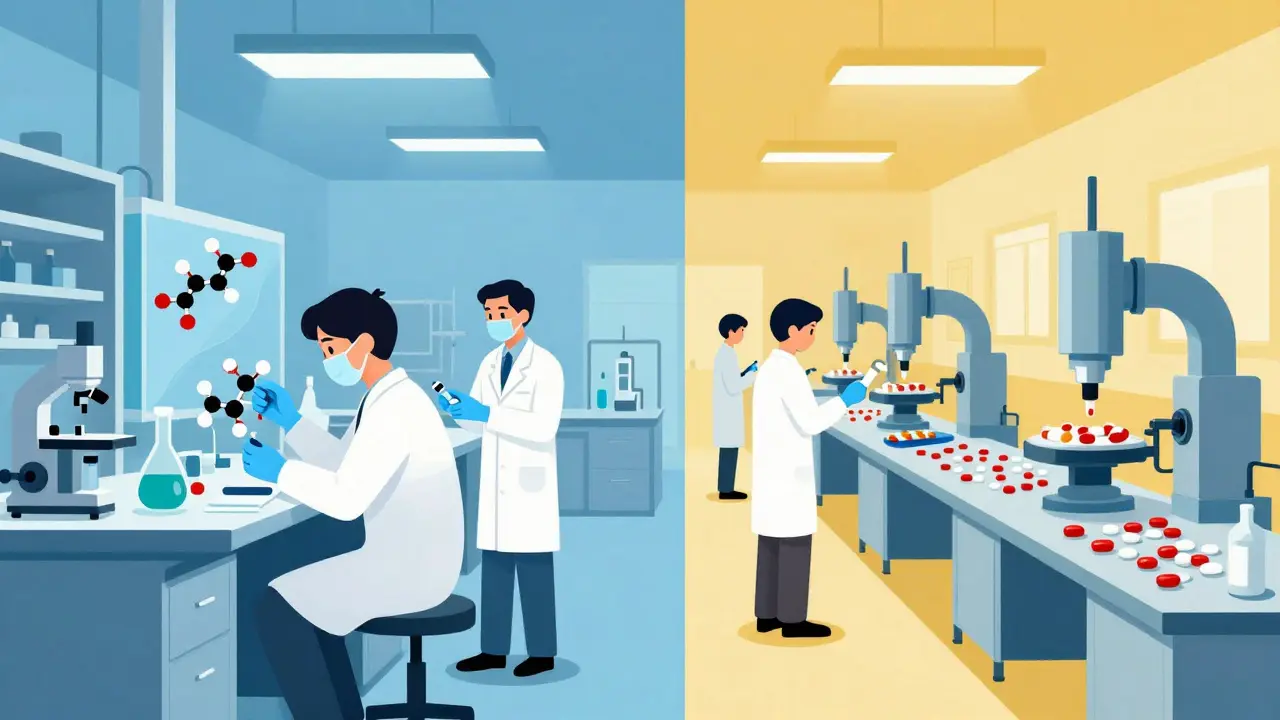
When you look under the hood of the pharmaceutical industry, the labor cost differences between generic and brand-name production become clear. Generic manufacturers operate on thin margins and high volume, squeezing every dollar out of efficiency. Brand-name companies, meanwhile, carry the heavy burden of recouping billions in research and development. This fundamental difference shapes everything from factory locations to quality control staffing.
The Real Cost Breakdown: Where Does Your Money Go?
To understand labor costs, we first need to look at the total bill. According to a 2023 analysis by Prosperous America, only $36 of every $100 spent on generic drugs goes toward actual production and manufacturing. Of that $36, roughly half-about $18-is allocated to direct production costs like active ingredients, packaging, and logistics. The other $18 is kept as gross profit to cover overhead, regulatory compliance, and yes, labor.
In contrast, brand-name drugs often command prices 80% to 85% higher than their generic counterparts, even when the active ingredients are chemically identical. UH Hospitals reported in 2022 that brand-name drugs account for nearly 75% of total prescription costs despite representing only 10% of prescriptions filled. That massive price gap exists because brand manufacturers must recover upfront investments. The FDA estimates that developing a new molecular entity costs approximately $2.6 billion on average and takes 10 to 15 years from discovery to market approval. Generic makers skip this entirely, allowing them to allocate far less capital to R&D and more to efficient, streamlined production.
| Cost Component | Generic Drugs | Brand-Name Drugs |
|---|---|---|
| Production & Manufacturing Share | $36 per $100 sold | Significantly lower % (due to high R&D/Marketing) |
| Labor Share of COGS | 15-25% | 30-40% (initial phases) |
| R&D Recovery Pressure | None (patents expired) | High ($2.6B avg per drug) |
| Price Premium | Baseline | 80-85% higher than generics |
Why Generic Labor Costs Are Lower
You might assume that making a cheaper drug means paying workers less. While wages play a role, the bigger driver is efficiency. A 2019 benchmark study by Boston Consulting Group (BCG) found that generic small-molecule manufacturers see a 27% unit cost reduction every time their production volume doubles. Compare that to biopharma companies, which only see a 17% reduction. This "economies of scale" effect means generic factories can spread fixed labor costs over millions more units, drastically lowering the labor cost per pill.
Additionally, generic formulations are often simpler. They don’t require the complex delivery systems or novel chemical stabilizers that many brand-name drugs use. Simpler formulas mean fewer steps in the manufacturing process, which translates to less specialized labor required on the floor. BCG data shows that generics producers see unit costs drop by 45% every time the number of units doubled, compared to just 29% for biopharma manufacturers. Labor productivity in generic manufacturing scales exceptionally well with volume.
The Hidden Burden: Quality Control and Compliance
If generic labor is so cheap, why isn’t the price even lower? The answer is regulation. You cannot cut corners on safety. In fact, quality control processes alone account for more than 20% of total generic drug production costs, according to a 2023 analysis by DrugPatentWatch. This is a highly labor-intensive component involving rigorous testing of raw materials, in-process checks, and final product verification.
Every batch must be meticulously documented for traceability. The FDA requires strict adherence to Good Manufacturing Practices (GMP). For a medium-sized firm with 20 to 500 employees, maintaining these compliance systems costs approximately $184,000 annually, based on a 2017 FDA analysis. Add in program participation fees and new drug application costs, and the financial pressure mounts. This "Cost of Quality" includes prevention costs (training staff), appraisal costs (testing), and failure costs (rework). Strategic investment in skilled labor for quality control actually saves money in the long run by reducing deviations and rework, but it keeps the labor floor relatively high compared to unregulated industries.
Geography Matters: The Global Labor Arbitrage
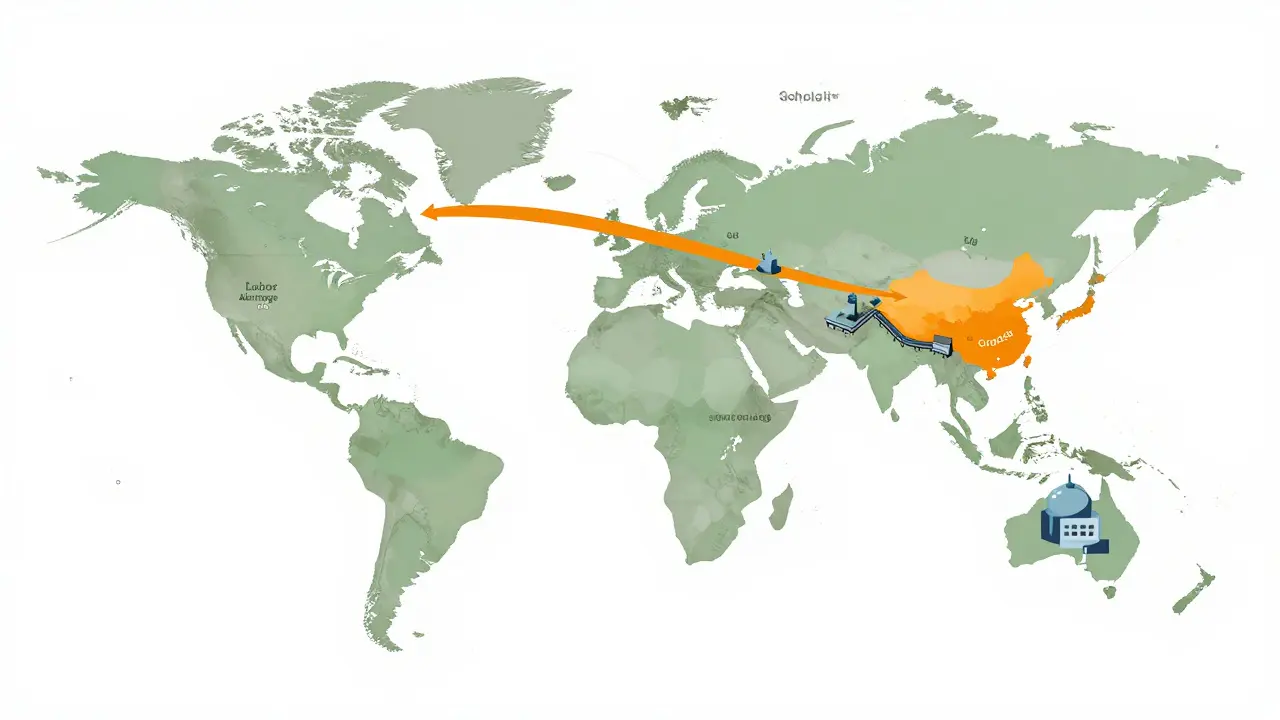
Where a drug is made has a massive impact on its labor cost. Many generic manufacturers source their Active Pharmaceutical Ingredients (APIs) from India and China. Prosperous America’s 2023 analysis reveals that API production in these countries is approximately 42% cheaper than in U.S. facilities. This cost advantage applies to the production slice of generic drug costs, translating to about a 15% lower cost at the pharmacy counter before tariffs or domestic economies of scale are considered.
However, this isn't always about superior technology. The HHS Office of the Assistant Secretary for Planning and Evaluation noted in a 2021 report that these international cost advantages often reflect "subsidies, lax labor and environmental standards, and scale dominance." Essentially, global labor arbitrage allows generic companies to keep prices low, but it also creates supply chain vulnerabilities. If labor standards shift or geopolitical tensions rise, those cost savings can vanish overnight.

Outsourcing: Turning Fixed Costs into Variable Ones
Another way generic manufacturers manage labor costs is by outsourcing. Instead of owning every factory, they increasingly rely on Contract Manufacturing Organizations (CMOs). BCG’s 2019 study highlighted that biosimilar business units spend 42% of their Cost of Goods Sold (COGS) on CMOs, compared to 28% for small-molecule units. By using CMOs, companies convert fixed labor costs (salaries, benefits, facility maintenance) into variable expenses. They pay for what they produce, optimizing labor utilization based on demand fluctuations rather than keeping a large permanent workforce idle during slow periods.
The Risk of Cutting Too Deep
There is a limit to how much labor cost can be cut. The FDA has warned that intense pricing pressure may force companies to adopt strategies that lower manufacturing costs too aggressively, potentially leading to supply disruptions and shortages. A 2023 FDA report acknowledged increasing attention on whether the lower cost of generic drugs places pressure on companies to reduce staffing levels or hire less experienced personnel. When labor costs are squeezed too tightly, quality can slip, leading to failed batches, recalls, and ultimately, higher costs due to waste and reputational damage.
Experts note that a manufacturer investing in prevention and consistent high-quality batches will have significantly lower total production costs and greater supply chain reliability. In other words, paying for competent, well-trained labor is an investment, not just an expense. The most successful generic manufacturers find the sweet spot where labor efficiency meets uncompromising quality standards.
Are generic drugs made with lower quality labor than brand names?
Not necessarily. Both generic and brand-name drugs must meet the same FDA safety and efficacy standards. However, generic manufacturers often achieve lower labor costs through higher production volumes, simpler formulations, and strategic outsourcing rather than hiring less qualified staff. In fact, skilled labor in quality control is critical for generics to avoid costly rework and ensure compliance.
Why do brand-name drugs cost so much more if production is similar?
Brand-name drugs include the cost of recovering massive Research and Development (R&D) investments, which average $2.6 billion per new drug and take 10-15 years. Generic manufacturers do not bear these upfront costs because the patents have expired, allowing them to price their products much lower while still covering production and labor expenses.
How does manufacturing location affect drug prices?
Manufacturing in countries with lower labor costs, such as India and China, can reduce API production costs by approximately 42% compared to U.S. facilities. This geographic arbitrage is a key factor in keeping generic drug prices low, though it can introduce supply chain risks related to labor standards and geopolitical stability.
What percentage of generic drug costs go to labor?
Labor constitutes approximately 15-25% of total manufacturing costs for generic drugs. This is lower than the 30-40% range typical for brand-name drugs during initial production phases. Quality control and regulatory compliance are significant labor-intensive components within this percentage.
Do generic manufacturers use contract labor?
Yes, many generic manufacturers use Contract Manufacturing Organizations (CMOs) to handle production. This strategy allows them to convert fixed labor costs into variable expenses, optimizing efficiency based on demand. Biosimilar units, for example, spend 42% of their Cost of Goods Sold on CMOs.