
If you’ve been living with knee pain from osteoarthritis, you’ve probably heard about hyaluronic acid injections. Maybe your doctor mentioned them after painkillers and physical therapy didn’t cut it. Or maybe you saw an ad online promising long-lasting relief. But here’s the truth: hyaluronic acid injections aren’t a magic fix. They’re not a scam either. The reality? They work-sometimes-for some people, and only under specific conditions.
What Are Hyaluronic Acid Injections?
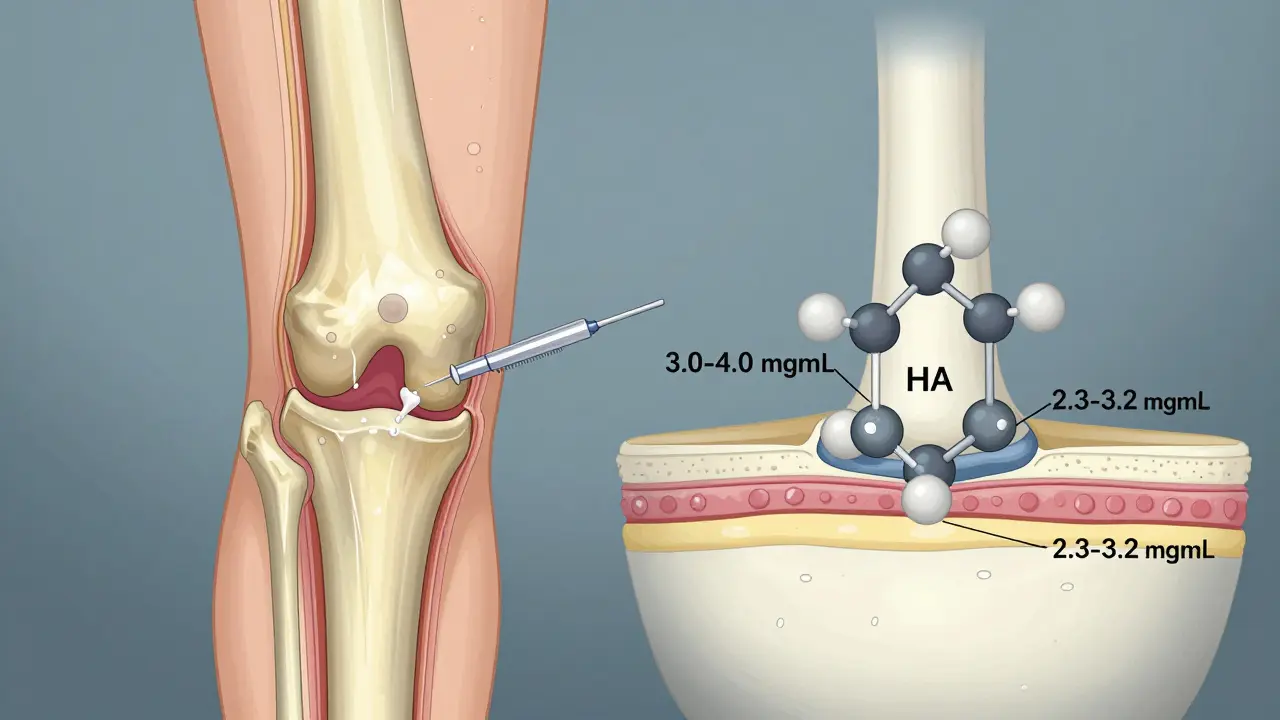
Hyaluronic acid (HA) is a natural substance found in your joints. It’s part of the synovial fluid-the gooey lubricant that keeps your knee moving smoothly. In a healthy knee, this fluid acts like oil in an engine: it reduces friction, absorbs shock, and protects the cartilage. But in osteoarthritis, that fluid breaks down. Studies show people with knee OA have 30-50% less hyaluronic acid than those without joint damage. The concentration drops from around 3.0-4.0 mg/mL to as low as 2.3-3.2 mg/mL.
Viscosupplementation-what doctors call HA injections-tries to fix that. A doctor injects a synthetic or lab-made version of hyaluronic acid directly into the knee. The idea is simple: replace what’s missing. More lubrication. Better cushioning. Less pain.
The first FDA-approved product, Hyalgan, came out in 1997. It was made from rooster combs (yes, really), which is why some patients still call them “rooster comb shots.” Today, most are made using bacterial fermentation, making them animal-free. But the core goal hasn’t changed: restore joint function by boosting what your body’s lost.
How Do They Work?
It’s not just about lubrication. While that’s the basic theory, research suggests HA injections do more:
- They help reduce inflammation inside the joint
- They may protect remaining cartilage by reducing harmful enzymes
- They might even stimulate your own cells to produce more natural hyaluronic acid
That’s why some doctors believe HA could be more than temporary relief-it might slow down damage. But here’s the catch: there’s no solid proof it changes the long-term course of osteoarthritis. No study has shown it prevents joint replacement. So don’t expect it to reverse your arthritis.
Who Gets These Injections?
Not everyone with knee pain qualifies. These injections are meant for people with mild to moderate osteoarthritis-specifically Kellgren-Lawrence grades 1 to 3. That means:
- Your X-ray shows some joint space narrowing, but not bone-on-bone contact
- You still have some cartilage left
- Pain comes and goes, but you’re not stuck in constant agony
If your knee is bone-on-bone (grade 4), HA injections won’t help. Henry Ford Health confirms this: no benefit for advanced OA. You’re better off considering other options like physical therapy, weight loss, or eventually, surgery.
Also, you should have tried the basics first. That means:
- Regular low-impact exercise (walking, swimming, cycling)
- Weight management if you’re overweight
- Over-the-counter pain relievers like acetaminophen or NSAIDs
Only if those don’t cut it do doctors consider HA injections. They’re not a first-line treatment. They’re a next step.
Types of HA Injections: Not All Are the Same
There are dozens of HA products on the market, and they’re not interchangeable. The differences matter.
| Product | Molecular Weight (kDa) | Number of Injections | Source | Key Notes |
|---|---|---|---|---|
| Hyalgan | 500 | 5 weekly | Avian (rooster comb) | Low MW; older formulation |
| Euflexxa | 6,000 | 3 weekly | Bacterial | Higher MW; common choice |
| Synvisc | 6,000 | 3 weekly | Bacterial | Often used; longer-lasting in some studies |
| Gel-One | 1,500-2,200 | 1 injection | Bacterial | Single-dose option; convenient |
| Orthovisc | 3,000-4,000 | 3-4 weekly | Bacterial | High viscosity; good for active patients |
Higher molecular weight doesn’t always mean better. A 2004 study by Altman found that ultra-high MW HA (100,000 kDa) showed no benefit over placebo. But other studies, like those by Johan et al., found high MW products delivered meaningful pain relief. So it’s not just about the number-it’s about how the molecule behaves in your joint.
Also, single-injection products like Gel-One are popular for convenience. But research from 2018 (cited in PMC9135165) shows multiple injections (3-5) work better than one. The Arthritis Foundation agrees: “Three doses were more effective than fewer doses.”

Do They Actually Work?
This is the big question. And the answer? It’s messy.
Some studies say yes. A 2022 meta-analysis by Concoff et al. found HA injections provided statistically significant pain relief compared to saline placebo-especially with 2-4 shots. Patients reported better mobility and less stiffness at 5-13 weeks. In fact, some people say their pain dropped by 40-60% for up to six months.
But other studies say no. A 2022 STAT News review of 50 years of data concluded HA injections are “barely more effective than the placebo effect.” The difference in pain scores between HA and saline was less than 9%-a difference most experts consider too small to matter in daily life.
Compare it to corticosteroid shots. Steroids give fast relief-often within days-but it fades after 4-6 weeks. HA takes longer to kick in (2-4 weeks), but the relief lasts longer-up to 26 weeks in some cases, according to Rodriguez-Merchan’s research. So if you want quick relief, go with steroids. If you want something that lasts, HA might be worth a try.
The NIH study from 2015 (PMC4311527) put it best: HA injections have “a modest effect on early to moderate knee OA.” That’s the sweet spot. Not a cure. Not a miracle. Just a modest, temporary help.
Side Effects and Risks
Most people tolerate HA injections well. But here’s what can go wrong:
- 10-20% feel temporary pain at the injection site
- 5-10% get swelling or warmth in the knee for a few days
- Less than 0.1% have serious allergic reactions
Swelling is the most common issue. If your knee swells up after the shot, it’s usually just inflammation from the needle. Rest, ice, and ibuprofen help. But if it gets worse, red, or hot, call your doctor-it could be an infection.
Contraindications? Avoid HA if you have:
- An infection near the injection site
- A known allergy to hyaluronic acid or bird proteins (for avian-derived products)
- A bleeding disorder or are on blood thinners (risk of internal bleeding)
And remember: never get HA injections if you have bone-on-bone arthritis. It’s a waste of time and money.
Cost and Insurance
In the U.S., Medicare spent over $300 million on HA injections in 2022. That’s a lot of money for a treatment with mixed results. A single course typically costs between $500 and $1,000 out-of-pocket. Insurance often covers it if you meet criteria (moderate OA, failed conservative care), but some plans require prior authorization.
Why does it cost so much? Because you’re paying for multiple visits. Three shots mean three office visits, three injections, three sets of supplies. Some clinics bundle the cost. Others charge per injection. Ask upfront.
And here’s the reality: if you don’t feel better after one full course, don’t repeat it. There’s no evidence that multiple courses over time improve outcomes.
What to Expect After the Injection
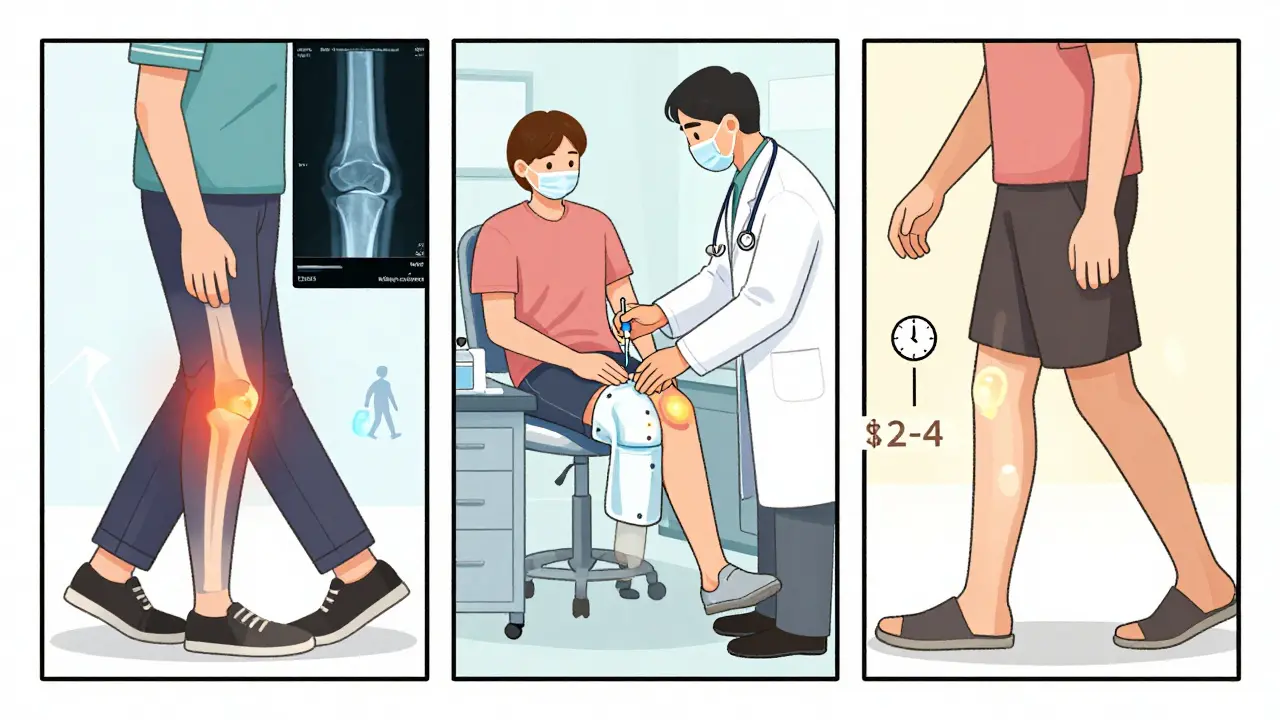
Don’t expect instant relief. It takes 2-4 weeks for the full effect to kick in. Some people feel worse before they feel better-especially in the first 48 hours. That’s normal.
After the shot:
- Rest your knee for 24-48 hours
- Avoid running, jumping, or heavy lifting
- Use ice if you feel swelling
- Resume walking and light activity after two days
Most patients can drive home and return to work the same day. No downtime. No anesthesia. Just a quick needle stick.
When to Skip HA Injections
These injections aren’t for everyone. Walk away if:
- You have severe OA (bone-on-bone)
- You’ve had a recent knee infection or surgery
- You’re allergic to bird proteins or HA
- You’ve tried two full courses and saw no benefit
- You’re looking for a permanent fix
And if you’re hoping to avoid surgery? HA injections won’t delay it. They might ease symptoms long enough to get through a tough season-but they don’t change the underlying disease.
The Bottom Line
Hyaluronic acid injections aren’t a miracle. They’re not a scam. They’re a middle-ground option for people with mild to moderate knee osteoarthritis who haven’t found relief elsewhere.
If you’re considering them:
- Make sure your OA isn’t advanced
- Try physical therapy and weight loss first
- Go with a multi-injection course (3-5 shots)
- Expect results in 2-4 weeks, not overnight
- Accept that relief may be modest and temporary
For some, it’s a game-changer. For others, it’s a costly distraction. The key is managing expectations. This isn’t about curing arthritis. It’s about buying yourself a few more months of comfortable movement.







8 Comments